
Bitcoin is a decentralized digital currency that operates independently of central authorities or financial institutions. Since its launch in 2009, it has become a widely discussed technological and economic innovation, attracting attention for both its potential uses and the security concerns surrounding its infrastructure and usage.
Although the Bitcoin protocol has not been compromised since its inception, the broader cryptocurrency ecosystem has experienced numerous security incidents. Attacks on exchanges, wallets, and users have resulted in substantial financial losses, raising ongoing concerns about the overall safety of holding and transacting in Bitcoin.
Security in the context of Bitcoin involves both the robustness of the network itself and the practices of individual users. While the core blockchain is secured through cryptographic and decentralized mechanisms, vulnerabilities often arise in the interfaces through which users access and manage their funds.
Understanding Bitcoin’s Security Model
The Role of Decentralization
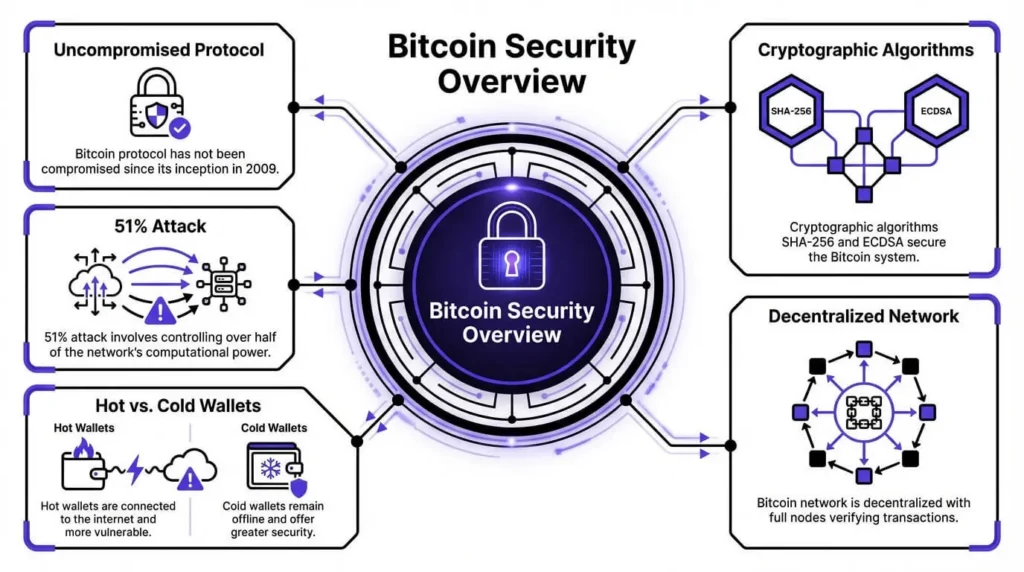
Each full node within the Bitcoin network stores a complete history of all transactions and participates in verifying new blocks. Because no single entity controls the network, altering the blockchain requires compromising a majority of the network’s computational power, a condition known as a 51% attack. Given the scale of the network, such an attack is considered technically and economically unfeasible.
Decentralization also enhances the network’s resilience. Even if a subset of nodes becomes unreachable due to localized disruptions, the remaining nodes can continue to operate without compromising data integrity or consensus.
Cryptographic Foundations of the Bitcoin Protocol
Bitcoin uses two principal cryptographic algorithms to secure its system: SHA-256 and ECDSA. SHA-256 supports the Proof of Work mechanism, which requires miners to expend significant computational effort to append new blocks to the blockchain. This process deters tampering by making it costly to alter historical data.
ECDSA (Elliptic Curve Digital Signature Algorithm) is employed to verify ownership of Bitcoins. Transactions must be signed with a private key corresponding to the sender’s address. Because only the holder of the private key can generate a valid signature, this mechanism effectively prevents unauthorized spending.
These cryptographic standards are widely used in digital security and have not been broken with current methods, providing a high level of assurance for the integrity of the Bitcoin protocol.
What Makes the Bitcoin Blockchain Tamper-Resistant?
The Bitcoin blockchain is structured as a linear sequence of blocks, each containing a cryptographic hash of the block that precedes it. This structure links all blocks in chronological order, forming an immutable chain of blocks. Modifying the contents of any one block would necessitate re-mining all subsequent blocks, which requires more computational power than the rest of the network combined.
In addition to technical safeguards, the network enforces consensus rules that reject any blocks that deviate from established protocol parameters. These rules help maintain uniformity and accuracy across all participating nodes, making the blockchain resistant to unauthorized alterations.
The Difference Between Network and User Security
Security within the Bitcoin ecosystem can be broadly divided into two distinct domains: the integrity of the Bitcoin network itself and the security practices of individual users. While the protocol has demonstrated strong resilience against technical compromise, users remain exposed to a range of risks primarily stemming from operational behavior, software vulnerabilities, and third-party services.
Bitcoin Network Security Explained
The Bitcoin network is protected through a distributed consensus mechanism known as Proof of Work. This system requires participants (miners) to solve complex mathematical problems to validate transactions and add them to the blockchain. These validations are continuously performed by thousands of nodes worldwide, ensuring that no single party can gain control over the ledger without a majority share of computational power.
This consensus-based structure prevents double-spending, unauthorized changes to transaction history, and central points of failure. As of now, the Bitcoin blockchain has never been successfully altered or compromised by external attackers. Its architecture is designed to be inherently resilient, with each node independently enforcing the protocol rules and rejecting invalid transactions or blocks.
Additionally, proposed changes to the protocol undergo extensive peer review and require widespread agreement from network participants. This conservative approach to protocol upgrades minimizes the risk of introducing security vulnerabilities.
Common Vulnerabilities in User Behavior
Despite the robustness of the underlying network, many security breaches in the Bitcoin ecosystem originate from human error, poor security hygiene, or reliance on insecure platforms. Users frequently fall victim to phishing attacks, fake wallet applications, and malicious software designed to harvest login credentials or private keys.
Storage practices are a major point of vulnerability. Bitcoin stored on centralized exchanges is susceptible to hacking incidents or insolvency events, as these platforms control the private keys on behalf of their users. The history of cryptocurrency includes several high-profile exchange breaches that have resulted in the loss of user funds.
Lack of two-factor authentication, weak passwords, and failure to update software further contribute to user-side risk. Unlike traditional financial systems, Bitcoin transactions are irreversible; once funds are transferred to an unauthorized address, they cannot be recovered.
The 51% Attack: Can Bitcoin’s Blockchain Be Manipulated?
While the Bitcoin protocol has proven resilient, one theoretical scenario, known as a 51% attack, remains a central concern in discussions about network-level vulnerabilities.
Understanding the 51% Attack Scenario
A commonly discussed theoretical vulnerability is the “51% attack.” This scenario involves a single entity or a coordinated group gaining control of more than half of the total computational power (hash rate) that secures the Bitcoin network. With such a majority, the attacker could attempt to:
- Reverse recent transactions, enabling double-spending
- Delay or censor new transactions
- Prevent specific users from having their transactions confirmed
However, even with the majority of hash power, the attacker would remain unable to:
- Steal bitcoins from other wallets without private key access
- Create new coins beyond the protocol’s issuance rules
- Rewrite the deep transaction history due to prohibitive computational demands
While disruptive, a 51% attack would not grant the attacker arbitrary control over the network or violate Bitcoin’s core cryptographic principles.
Barriers to a Network Takeover
Executing a 51% attack in practice is highly improbable. The Bitcoin network operates at a global scale with an exceptionally high hash rate, requiring:
- Billions of dollars in specialized mining hardware (ASICs)
- Access to vast amounts of electricity at low cost
- Technical capacity to deploy and maintain infrastructure at scale
Such an operation would also need to be sustained over time to succeed. Meanwhile, the Bitcoin community, including developers, miners, and node operators, would likely respond to the threat through protocol upgrades, soft forks, or the reallocation of mining resources.
Moreover, any perceived compromise could severely impact market confidence, causing the price of bitcoin to drop and devaluing the attacker’s holdings. These factors combine to create a powerful economic disincentive against attempting a takeover.
Incentives That Promote Network Integrity
Bitcoin’s security is reinforced by a system of aligned incentives. Miners receive block rewards and transaction fees for their honest participation, making adherence to the consensus rules more profitable than attempting to attack the network. An adversarial action risks losing these rewards and damaging the long-term viability of their investment.
This alignment of interests between miners, developers, and users supports a self-regulating system. By making malicious behavior economically irrational, Bitcoin’s design promotes the continued integrity of its blockchain.
Securing Bitcoin Wallets and Private Keys
Bitcoin ownership is fundamentally tied to the control of private cryptographic keys. These keys are used to authorize transactions and prove ownership of funds. Unlike traditional banking systems, where identity and recourse mechanisms can assist in recovering lost access, Bitcoin places full responsibility for security on the user. If a private key is lost or compromised, the associated bitcoins cannot be retrieved, making secure key management essential.
Why Private Keys Are Critical and Vulnerable
Private keys serve as the sole means of controlling Bitcoin funds. Whoever possesses the key can transfer the coins, regardless of how they obtained it. This makes private keys both the foundation of Bitcoin’s security model and its most fragile component.
Their vulnerability stems not from flaws in the cryptography but from user behavior and storage practices. Keys stored on internet-connected devices are exposed to malware, keyloggers, and remote-access attacks. If stored in cloud services or unencrypted local files, they become vulnerable to phishing, account breaches, or unauthorized third-party access. To mitigate these risks, best practices recommend using offline storage, securing backups in multiple physical locations, and utilizing dedicated hardware for key management.
Hot vs. Cold Wallets: Pros and Risks
Wallets, tools that store and manage private keys, come in two general categories: hot and cold.
Hot wallets are connected to the internet, making them suitable for frequent transactions but inherently more exposed to online threats. These include desktop, mobile, and browser-based wallets, which are vulnerable to system-level exploits and phishing campaigns.
Cold wallets, on the other hand, remain offline except when they are used to sign transactions. They include hardware wallets, air-gapped computers, and even paper wallets. While offering greater protection from remote attacks, they require careful physical handling and secure backup strategies to prevent loss due to damage, theft, or misplacement.
The trade-off between convenience and security is central to selecting a wallet. Active users may use hot wallets for everyday use while reserving cold wallets for long-term storage.
Custodial vs. Self-Custodial: Who Holds the Keys?
A key distinction in wallet security is whether the user or a third party holds the private keys.
Custodial wallets, typically offered by exchanges or financial platforms, manage users’ keys on their behalf. While convenient and often integrated with trading services, they introduce reliance on the provider’s security infrastructure. If the platform is hacked or becomes insolvent, users risk losing access to their funds.
Self-custodial wallets place the responsibility entirely on the user, who retains full control of their private keys. This approach aligns with Bitcoin’s principle of decentralization but also demands technical understanding and diligence in protecting those keys.
Choosing between custodial and self-custodial solutions depends on the user’s needs, risk tolerance, and willingness to manage their own security.
Phishing, Malware, and Common User Mistakes
Many Bitcoin losses occur not due to flaws in the technology but because of human error and targeted attacks. Common threats include:
- Phishing, where malicious actors impersonate legitimate services to steal login credentials or seed phrases.
- Malware, such as clipboard hijackers or keyloggers, operates silently to intercept sensitive data.
- Insecure backups include storing recovery phrases in cloud storage or plaintext files.
- Weak authentication, such as reusing passwords or failing to enable two-factor authentication.
Preventative measures include using hardware wallets, installing antivirus software, maintaining device hygiene, and avoiding unknown links or applications. Users are also encouraged to test backups periodically and educate themselves on current attack vectors.
Is Bitcoin Vulnerable to Emerging Technologies?
Emerging technologies such as quantum computing and advanced artificial intelligence have prompted new discussions about the long-term resilience of blockchain networks. While Bitcoin is currently considered secure against conventional attacks, the development of disruptive technologies could challenge existing assumptions about its invulnerability.
Cryptographic Risks in a Post-Quantum Era
Bitcoin relies heavily on cryptographic algorithms to secure transactions and maintain the integrity of its blockchain. The most critical among these are:
- ECDSA (Elliptic Curve Digital Signature Algorithm), used to verify transaction authenticity.
- SHA-256, a hash function employed in Bitcoin’s Proof-of-Work consensus.
Both systems are considered secure under classical computing models. However, in a post-quantum context, their robustness becomes uncertain. Quantum computers, if sufficiently advanced, could theoretically break elliptic curve cryptography using Shor’s algorithm, thereby compromising private keys and enabling the unauthorized transfer of funds.
SHA-256 is less directly threatened by quantum algorithms; however, Grover’s algorithm could potentially halve its effective security level, enabling faster brute-force attacks. Nonetheless, achieving the scale of quantum power needed for practical attacks remains, for now, a theoretical concern.
Bitcoin developers and researchers have acknowledged this risk, and proposals have been made to transition the protocol to quantum-resistant signature schemes if the technology becomes a credible threat. Migration, however, would require widespread coordination and may impose significant logistical and computational costs on the network.
The Role of Artificial Intelligence in Bitcoin Security
Artificial intelligence (AI), although not inherently malicious, can be leveraged by attackers targeting the Bitcoin ecosystem to augment their capabilities. It is essential to distinguish between attacks on the Bitcoin network itself and those targeting individual users or the supporting infrastructure. Currently, AI does not pose a direct threat to the Bitcoin protocol; however, it can enhance the sophistication of user-focused attack vectors.
AI-enhanced tools have been employed in:
- Phishing and impersonation attacks involve machine learning models generating realistic messages or deepfake content to deceive users.
- Behavioral analysis enables attackers to model user habits and identify potential security vulnerabilities.
- Malware development enables automated adaptation to different environments and evasion of traditional security software.
Such tools can increase the effectiveness of efforts to obtain private keys, passwords, or other sensitive information. However, AI does not enable attackers to bypass the cryptographic mechanisms that protect the Bitcoin blockchain itself. It cannot reverse SHA-256 hashes, forge ECDSA signatures, or manipulate the consensus process.
The security of the core Bitcoin protocol remains dependent on mathematical hardness assumptions, not on human fallibility. While AI may pose a threat to users who rely on poor security practices or centralized platforms, it does not currently compromise the network’s structural security.
Bitcoin vs. Traditional Financial Systems: A Security Comparison
The security architecture of Bitcoin differs fundamentally from that of conventional financial institutions. Traditional systems, such as banks, payment processors, and credit card networks, operate under centralized control, wherein a single entity or a consortium governs access, security, and transaction processing. These institutions implement layered cybersecurity measures, including encryption, fraud detection algorithms, and regulatory oversight, but remain vulnerable to targeted breaches, insider threats, and single points of failure.
In contrast, Bitcoin relies on decentralized consensus, cryptographic proofs, and a transparent ledger distributed across thousands of nodes worldwide. This decentralized model eliminates central points of control, making systemic compromise significantly more difficult. However, it also shifts the burden of security onto the individual user, particularly regarding the management of private keys and wallet credentials.
Traditional systems offer recourse mechanisms, such as customer support and transaction reversibility, which Bitcoin lacks by design. As a result, while Bitcoin’s core network exhibits a high degree of technical resilience, its user-facing components require a higher level of individual security literacy to match the practical protections offered by traditional finance.
Can Bitcoin Be Shut Down or Censored?
Bitcoin’s decentralized architecture was intentionally designed to resist censorship, control, or shutdown by any single entity. Unlike traditional systems that rely on central servers or authorities, Bitcoin is maintained by a globally distributed network of nodes, each of which independently verifies and relays transactions. This structural redundancy grants the protocol a high level of resilience, making it difficult to suspend or censor the network as a whole.
While local jurisdictions may restrict access to exchanges or criminalize specific uses of cryptocurrencies, the Bitcoin network itself has demonstrated robust resistance to direct interference. Its open-source nature and permissionless participation model enable it to persist even under adverse regulatory or technological conditions.
Network Resilience in the Face of Global Disruptions
For Bitcoin to be completely shut down, global and simultaneous disruptions would be required across the entire network, a scenario that is both technologically and logistically improbable. Each full node maintains a copy of the blockchain and can operate independently. Even if a significant portion of the network were taken offline, the remaining nodes would continue to validate transactions and preserve consensus.
Instances of partial network outages, such as internet blackouts or regional shutdowns, have occurred without impacting the integrity of the broader Bitcoin ledger. This resilience is underpinned by the absence of a single point of failure, as well as the network’s ability to self-heal when disconnected nodes reconnect and resynchronize.
Offline Nodes and Alternative Communication Channels
Bitcoin nodes are not exclusively dependent on traditional internet infrastructure. In regions with restricted access, nodes have been operated using mesh networks, radio waves, and even satellite connections. Blockstream’s satellite network, for example, broadcasts the Bitcoin blockchain to almost every continent, allowing receivers to download blockchain data without requiring internet access.
Such alternative communication methods are crucial for maintaining the network’s accessibility and autonomy, particularly in jurisdictions that attempt to curtail digital financial tools. They also ensure continuity in the event of natural disasters or large-scale network disruptions.
Legal and Political Limitations to Suppressing Bitcoin
Although governments have the power to regulate the use of Bitcoin within their borders by banning exchanges, taxing transactions, or criminalizing unauthorized crypto activity, they cannot directly alter the protocol or forcibly remove it from existence. At most, regulatory pressure can limit adoption or disincentivize participation through legal risk.
However, any attempt at coordinated global suppression would face significant political and logistical hurdles. Bitcoin operates across thousands of independent jurisdictions, many of which view its decentralized nature as a safeguard against economic instability or political interference. Additionally, enforcement of such a ban would likely push Bitcoin use further underground, without eliminating the protocol itself.

How to Protect Your Bitcoin from External Threats
While the Bitcoin protocol itself is considered highly secure, the broader ecosystem, particularly the points where individuals interact with their coins, is susceptible to a range of threats. Phishing attacks, malware, weak credentials, and insecure storage practices have been responsible for the vast majority of Bitcoin losses. As such, user-side security remains a critical component in preserving the integrity of one’s holdings.
Self-Custody Best Practices
Self-custody refers to the practice of maintaining full control over one’s private keys, as opposed to entrusting them to a third party such as a cryptocurrency exchange. This approach aligns with the fundamental philosophy of Bitcoin, which is to eliminate intermediaries in favor of user sovereignty.
To effectively manage self-custody, individuals must ensure their private keys are generated, stored, and accessed securely. Wallet software should be sourced from reputable developers and verified before use. Recovery phrases, commonly used to regenerate wallets, should be written down and stored offline in multiple geographically dispersed locations. These practices reduce the risk of digital theft and ensure recoverability in the event of device failure.
The responsibility of self-custody cannot be overstated. While it offers maximum control, it also entails maximum liability: if the keys are lost or compromised, there is no institutional mechanism for recovering the assets.
Hardware Wallets and Cold Storage Explained
Hardware wallets are physical devices designed to store private keys in an isolated environment securely. These wallets typically remain offline, making them a form of “cold storage”, and only connect to the internet temporarily when signing transactions. Because the private key never leaves the device, even a compromised computer cannot access it.
Popular hardware wallets include devices such as Ledger, Trezor, and Coldcard. Each offers varying features related to usability, compatibility, and physical security. When configured properly, hardware wallets provide one of the most secure methods for storing Bitcoin, particularly for long-term holdings.
Cold storage, more broadly, encompasses any method of keeping private keys offline. In addition to hardware wallets, this category includes air-gapped computers, encrypted USB drives, and even paper wallets. While less convenient for frequent transactions, cold storage significantly reduces the attack surface available to hackers.
Importance of Two-Factor Authentication and Secure Devices
Two-factor authentication (2FA) adds a critical layer of security to Bitcoin wallets and exchange accounts. By requiring a second verification step, typically through a time-sensitive code generated by a separate device or app, 2FA makes unauthorized access substantially more difficult, even if a password is compromised.
For maximum effectiveness, users should avoid SMS-based two-factor authentication (2FA), which is vulnerable to SIM-swapping attacks. Authenticator apps, such as Google Authenticator, or hardware tokens, like YubiKey, are considered more secure alternatives.
In parallel, maintaining device security is essential. Wallet applications should only be installed on devices with updated operating systems and reputable antivirus software. Rooted or jailbroken devices should be avoided entirely, as they undermine the underlying protections offered by modern operating systems. In cases where large sums of Bitcoin are stored, it may be prudent to use a dedicated device for wallet management, disconnected from everyday browsing or applications.
Avoiding Cloud Storage and Common Mistakes
Storing private keys, seed phrases, or wallet backups in cloud services (Google Drive, Dropbox, or iCloud) poses a significant security risk. These platforms, while convenient, are frequent targets for phishing campaigns and credential stuffing attacks. Once accessed, cloud-based wallet information can be used to irreversibly steal funds.
Common mistakes made by users include reusing passwords across services, storing recovery phrases in plaintext on a computer, and clicking on suspicious links in unsolicited emails. Each of these behaviors can provide an entry point for attackers.
To mitigate these risks, users should employ password managers with strong, unique credentials and use encrypted local storage when digital backups are absolutely necessary. Additionally, performing regular operational security reviews, such as checking for unauthorized access or ensuring backup redundancy, can help maintain long-term safety.
Major Security Breaches in the Crypto Ecosystem
While the Bitcoin protocol itself has remained technically uncompromised, the broader cryptocurrency ecosystem has seen numerous high-profile breaches resulting in the loss of billions of dollars. These incidents serve as cautionary examples of where vulnerabilities often lie, not within the blockchain itself, but rather within exchanges, smart contracts, and user practices. The following cases illustrate how different architectural flaws and operational oversights have led to systemic failures.
Mt. Gox and the Collapse of Early Exchanges
The collapse of Mt. Gox in 2014 remains the most infamous event in the history of cryptocurrency security. Founded in Japan and once responsible for handling over 70% of all Bitcoin transactions worldwide, Mt. Gox lost an estimated 850,000 BTC, worth hundreds of millions of dollars at the time, due to a combination of long-term theft and inadequate internal accounting systems.
Investigations revealed that the exchange had been leaking coins for years without detection, primarily due to poor wallet management and the absence of proper auditing procedures. The incident underscored the dangers of centralized custodianship and marked a pivotal moment that shifted industry focus toward self-custody and transparency.
The Poly Network and the Role of Smart Contract Flaws
In August 2021, Poly Network, a decentralized finance (DeFi) platform facilitating cross-chain asset transfers, was exploited through a vulnerability in its smart contract code. The attacker was able to override transaction permissions, draining over $600 million in various cryptocurrencies.
In a surprising turn, the individual later returned most of the stolen assets, claiming the act was intended to expose the platform’s weaknesses. Nevertheless, the event highlighted how even non-custodial systems can harbor critical security flaws, particularly in the design and deployment of complex smart contracts. The Poly Network case highlighted the importance of third-party code audits and formal verification in decentralized finance (DeFi) development.
Binance, Coincheck, and the Cost of Centralization
Despite employing robust security protocols, major exchanges such as Binance and Coincheck have experienced breaches, highlighting the risks associated with centralized asset storage.
In 2018, Coincheck lost over $500 million worth of NEM tokens after attackers infiltrated a hot wallet with inadequate security measures. The funds were never fully recovered, prompting regulators in Japan to tighten operational requirements for crypto exchanges.
In 2019, Binance suffered a loss of over 7,000 BTC when hackers exploited a combination of phishing, malware, and access to application programming interfaces (APIs) to circumvent the platform’s security. Binance subsequently covered the loss through its internal insurance fund and enhanced its security protocols. Still, the breach demonstrated that even the most technologically advanced platforms remain targets, and that centralization concentrates risk in a single point of failure.
FAQ
What Happens if I Lose Access to my Bitcoin Wallet?
Losing access to a Bitcoin wallet typically means losing access to the funds it holds, unless proper backup procedures were followed. Bitcoin wallets are secured by private keys or seed phrases, which are not stored on any centralized server. If the private key or recovery phrase is lost and no backup exists, there is no mechanism to retrieve the funds. For this reason, wallet providers strongly recommend that users securely store their recovery phrases offline and in multiple secure locations.
Can Bitcoin Transactions be Reversed if Sent to the Wrong Address?
Bitcoin transactions are irreversible by design. Once a transaction is broadcast to the network and confirmed, it becomes a permanent part of the blockchain ledger. There is no institution or authority capable of reversing or recovering funds that have been mistakenly sent. Sending Bitcoin to an incorrect or invalid address may result in a complete loss of funds. As a precaution, users are advised to double-check recipient addresses and use small test transactions when transferring large amounts.
What’s the Risk of Using Public Wi-Fi for Bitcoin Transactions?
Conducting Bitcoin transactions over unsecured public Wi-Fi networks introduces significant risks. Attackers can intercept data using techniques such as packet sniffing or man-in-the-middle attacks, potentially exposing login credentials or private information. This risk is elevated when using web wallets or exchange platforms through browsers. For secure use, it is recommended to avoid public Wi-Fi altogether or, at the very least, use a trusted VPN and enable multi-factor authentication on all cryptocurrency-related services.
Can Governments Trace Bitcoin Transactions?
Despite its pseudonymous nature, Bitcoin is not fully anonymous. All Bitcoin transactions are recorded on a public ledger, which can be analyzed by blockchain forensic tools. Governments and regulatory agencies increasingly employ blockchain analytics firms to trace funds and link addresses to individuals or entities. While personal identities are not recorded on the blockchain, they can sometimes be inferred through exchange data, IP tracking, or transaction patterns. Users seeking greater privacy often explore additional tools or privacy-focused cryptocurrencies, although these may carry legal implications in some jurisdictions.
What Security Measures Should I Take When Gifting Bitcoin?
When transferring Bitcoin as a gift, special attention must be given to the security of both the sender and the recipient. Using a hardware wallet or generating a new, dedicated wallet address for the gift is recommended. The recipient should be advised to safely store their private key or recovery phrase and refrain from storing sensitive data in digital or cloud-based locations. Additionally, gifting via custodial services may offer convenience but transfers responsibility for security to the platform, which may not align with long-term self-custody principles.
Risks in Open-Source Wallets and Code Dependencies
While open-source wallets promote transparency, they can still be exploited if malicious code is introduced through third-party libraries or updates. Users are advised only to download wallet software from verified repositories and monitor official communication channels for potential security alerts.
Leave a Reply