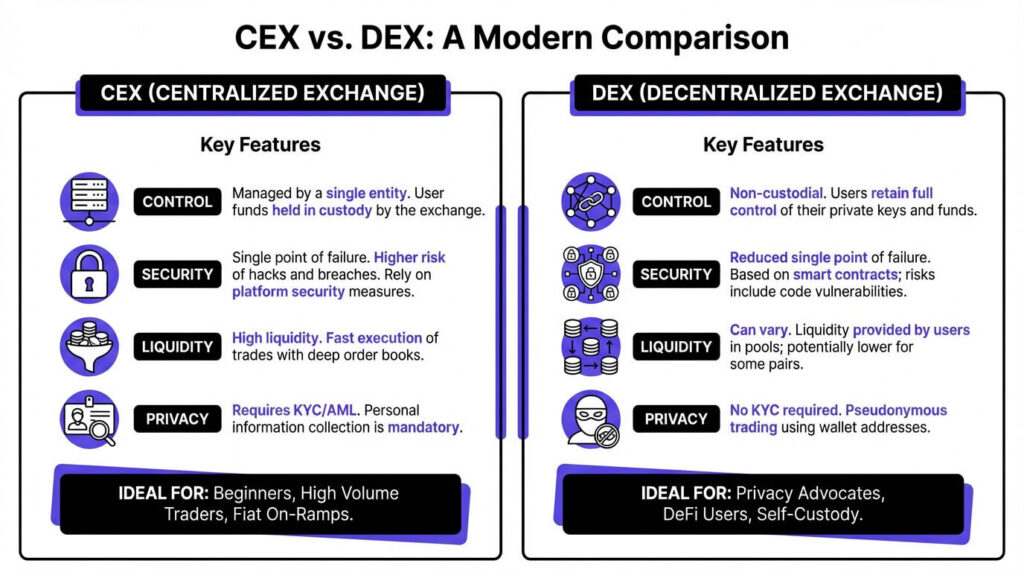
Centralized exchanges (CEXs) and decentralized exchanges (DEXs) represent two distinct models for facilitating the trading of cryptocurrencies and digital assets. While both function as platforms for asset exchange, they differ fundamentally in terms of custody, governance, user control, regulatory compliance, and risk exposure. This article outlines the core characteristics of each model, compares their advantages and limitations, and examines their roles within the broader cryptocurrency ecosystem.
What Is a Centralized Exchange (CEX)?
A centralized exchange (CEX) is a platform that facilitates the trading of digital assets through a system managed by a central authority, usually a registered company. These exchanges operate similarly to traditional brokerage services, providing user accounts, managing order books, and often holding users’ assets in custodial wallets.
Centralized platforms such as Binance, Coinbase, and Kraken are known for offering high liquidity, fast execution, and user-friendly interfaces. They frequently support fiat-to-crypto transactions and provide features such as margin trading, staking, and advanced order types.
However, their custodial nature means users must entrust the platform with their funds. This introduces potential security and operational risks, such as hacking or temporary withdrawal limits. Additionally, regulatory compliance requires centralized exchanges to implement Know Your Customer (KYC) verification, which can limit privacy.
What Is a Decentralized Exchange (DEX)?
A decentralized exchange (DEX) enables users to trade cryptocurrencies directly from their wallets by interacting with smart contracts on a blockchain. Unlike centralized platforms, DEXs do not rely on a central operator or hold users’ assets; instead, trades are executed peer-to-peer.
DEXs, such as Uniswap, PancakeSwap, and SushiSwap, operate on networks like Ethereum or BNB Chain, offering an open and permissionless environment. This approach gives users greater control over their funds and removes the need for identity verification, appealing to those who prioritize privacy and autonomy.
Despite these advantages, DEXs often require a higher level of technical knowledge. Users must manage their own wallets, navigate complex interfaces, and pay transaction fees associated with blockchain transactions. Liquidity can also vary across assets, and the absence of customer support means users bear full responsibility for their interactions.
CEX vs DEX: Structural Overview
Feature
Centralized Exchange (CEX)
Decentralized Exchange (DEX)
Custody of Funds
Held by the platform
Held by the user
Control Model
Operated by a central authority
Governed by smart contracts and protocols
User Registration
Requires KYC and identity verification
Usually does not require registration
Access Method
Account-based access via login credentials
Wallet-based access (e.g., MetaMask)
Liquidity
Generally high, especially for major assets
Varies by token and platform
Fiat Support
Common (bank transfers, credit cards)
Rare; mostly crypto-to-crypto
Interface Design
Typically user-friendly and polished
Can be complex or technical for newcomers
Regulatory Status
Often licensed and regulated
Largely unregulated (varies by jurisdiction)
Security Risk
Prone to centralized hacks and custodial failures
No custodial risk, but smart contract risk exists
Support Services
Offers customer support
No formal support; self-service only
CEX vs DEX: A Head-to-Head Comparison
Although centralized and decentralized exchanges serve the same core purpose, enabling the trading of cryptocurrencies, their operational frameworks differ significantly. These differences influence not only how users interact with them, but also how risk, accessibility, and functionality are distributed.
Custody and Control
Centralized exchanges take custody of user funds and manage transactions internally. This custodial model can simplify the trading experience but introduces risks associated with centralized control. In contrast, decentralized exchanges allow users to retain control over their assets by connecting directly through their wallets. Trades are executed via blockchain smart contracts, with no intermediaries involved.
Security and Risk Profile
Security considerations vary between models. CEX platforms are attractive targets for hackers due to their asset concentration, but they typically employ strong security infrastructure. DEXs avoid this centralized risk by design; however, they depend on the integrity of their smart contracts, which can contain exploitable vulnerabilities if not properly audited.
Liquidity and Market Depth
Centralized exchanges typically offer higher liquidity, enabling smoother and faster execution of large orders. DEXs may struggle with slippage, especially for low-volume tokens, though this gap is closing as decentralized liquidity protocols evolve.
Ease of Use and Accessibility
User experience is often smoother on CEX platforms, thanks to intuitive design, integrated fiat onramps, and customer support. DEX platforms require users to manage their own wallets and sign on-chain transactions, which can be a barrier for less technical participants.
Regulatory Environment
CEXs usually operate under jurisdictional licenses and must comply with KYC and AML regulations. DEXs are often open-source and community-governed, existing in legal grey zones where regulatory compliance may be limited or absent.
Summary Table: CEX vs DEX Structural Overview
Feature
Centralized Exchange (CEX)
Decentralized Exchange (DEX)
Custody of Funds
Held by the platform
Held by the user
Control Model
Operated by a central authority
Governed by smart contracts and protocols
User Registration
Requires KYC and identity verification
Usually does not require registration
Access Method
Account-based access via login credentials
Wallet-based access (e.g., MetaMask)
Liquidity
Generally high, especially for major assets
Varies by token and platform
Fiat Support
Common (bank transfers, credit cards)
Rare; mostly crypto-to-crypto
Interface Design
Typically user-friendly and polished
It can be complex or technical for newcomers
Regulatory Status
Often licensed and regulated
Largely unregulated (varies by jurisdiction)
Security Risk
Prone to centralized hacks and custodial failures
No custodial risk, but smart contract risk exists
Support Services
Offers customer support
No formal support; self-service only
When to Use a CEX vs a DEX
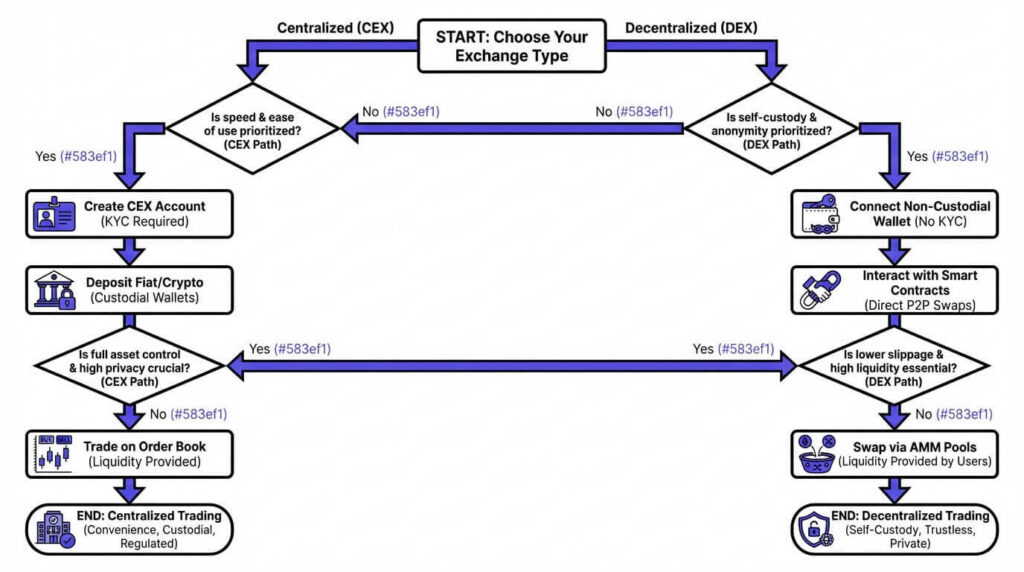
Choosing between a centralized and decentralized exchange often depends on the user’s needs, technical proficiency, and trading goals. While both types of platforms serve as access points to the crypto economy, they differ in how they balance usability, control, and risk.
For new users, centralized exchanges often provide a more accessible entry point. The ability to deposit fiat currencies, reset lost credentials, and receive customer support reduces the complexity of early interactions with digital assets. CEXs are typically used when fast execution, deep liquidity, and access to a broad range of trading pairs are prioritized.
More experienced users, or those with a strong preference for self-custody and privacy, may choose decentralized exchanges. Since DEXs do not require identity verification, they allow for pseudonymous trading and full control of private keys. This is particularly relevant in regions with restricted access to financial infrastructure or where regulatory environments are uncertain.
DEXs also play a vital role in token discovery. Many new or experimental tokens are first available through decentralized liquidity pools before listing on major centralized platforms. This makes DEXs a preferred environment for early-stage traders and developers.
That said, many participants in the crypto ecosystem use both models depending on context. For instance, a user may purchase assets through a CEX for convenience, then move funds to a self-custodied wallet to interact with decentralized protocols. This hybrid approach is increasingly common as users seek both flexibility and control.
Strategic Considerations in Choosing a Crypto Exchange Model
Cryptocurrency exchanges, both centralized and decentralized, serve as critical infrastructure in the digital asset ecosystem. Rather than representing mutually exclusive paradigms, CEXs and DEXs increasingly coexist as part of a complementary trading strategy.
From a strategic standpoint, centralized exchanges remain the primary access point for fiat-to-crypto onboarding, offering deep liquidity, regulatory compliance, and structured support systems. This makes them particularly suited for institutional participants, high-frequency trading, and users prioritizing convenience and speed.
Decentralized exchanges, meanwhile, offer structural advantages aligned with the principles of financial sovereignty and protocol-level transparency. Their non-custodial architecture enables direct control over digital assets and provides broader token exposure, particularly for early-stage projects or unlisted assets. However, users must navigate risks associated with smart contracts, interface complexity, and a lack of formal support.
In practice, many participants adopt a hybrid strategy: acquiring assets on a CEX, transferring them to a self-custodied wallet, and interacting with DEX protocols for liquidity mining, yield farming, or accessing niche assets. This reflects a maturing user base that values both operational efficiency and decentralized control.
As regulatory frameworks evolve and hybrid platforms gain traction, the distinction between CEX and DEX is becoming less binary. Exchanges are beginning to integrate features from both models, aiming to offer compliant, non-custodial trading with enhanced UX. Future-ready users will likely rely on platforms that balance regulatory alignment with the ethos of decentralization.
Decision Matrix
Strategic Priority
Exchange Type
Fiat access, high-volume trading
Centralized Exchange (CEX)
Self-custody, privacy, autonomy
Decentralized Exchange (DEX)
Token discovery, niche assets
Decentralized Exchange (DEX)
Customer support & recovery
Centralized Exchange (CEX)
Permissionless DeFi access
Decentralized Exchange (DEX)
KYC-compliant access
Centralized Exchange (CEX)
FAQ
Is a CEX more secure than a DEX?
Each model carries its own set of risks. Centralized exchanges typically invest in advanced security infrastructure but present a single point of failure, making them attractive targets for hackers. Decentralized exchanges eliminate custodial risk but rely on smart contracts, which may contain bugs or vulnerabilities if unaudited. The concept of “security” depends on whether a user is more concerned about platform breaches or contract-level exploits.
Which type of exchange offers more privacy?
Decentralized exchanges generally allow users to trade without completing identity verification processes. This offers a higher degree of privacy compared to centralized platforms, which are usually obligated to collect personal data in compliance with regulatory standards. However, blockchain transactions on DEXs are public and traceable, so privacy is not absolute.
Can I use both CEX and DEX?
Yes. Many users operate across both platforms, depending on the use case. For example, one might purchase crypto through a CEX using fiat and then move those assets to a self-custodied wallet for use on a DEX. Using both types of exchanges allows users to balance convenience, control, and access to specific assets.
What is a DEX wallet?
A DEX wallet is a non-custodial wallet, such as MetaMask or Trust Wallet, that connects directly to decentralized protocols. These wallets allow users to manage their private keys and sign blockchain transactions, including token swaps, without involving a third party.
Is Binance a DEX or a CEX?
Binance is primarily a centralized exchange (CEX). However, it has also launched a decentralized trading platform called Binance DEX, which operates independently of the main exchange. Users should distinguish between the two, as they have different custody models, interfaces, and regulatory frameworks.
Can I Stake or Earn Yield on Both CEXs and DEXs?
Yes, but the mechanisms differ. CEXs offer staking and yield products as managed services, often with fixed rates and terms. DEXs support yield farming and liquidity provision directly through smart contracts, typically offering higher but more variable returns — along with greater risk.
What are the Risks of Using a DEX for the First Time?
First-time DEX users often face risks such as sending funds to the wrong address, interacting with malicious contracts, or overpaying for gas fees. There is also no customer support. Learning to use a non-custodial wallet and verifying smart contract integrity are critical steps before trading.
Can I Trade the Same Tokens on Both CEXs and DEXs?
Not always. While popular tokens like BTC and ETH are typically available on both, many new or experimental tokens are first launched on DEXs. CEXs often list assets only after legal, liquidity, and compliance checks, which can limit early access.
Most of the time, you need more than one wallet to safely manage your cryptocurrency. Different use cases need different setups, such as for long-term saving, daily transactions, and interacting with DeFi (decentralized finance) protocols.
This guide will talk about how many crypto wallets you might need, why having multiple wallets is good for security and privacy, and how to set up a wallet system that works for you.
What Is a Crypto Wallet?
A crypto wallet is a software program that lets people store, watch over, and use cryptocurrencies and other digital assets safely. A crypto wallet is different from other wallets because it doesn’t hold cash. Instead, it protects the cryptography keys that let you access blockchain-based funds. These wallets are necessary for anyone who works with cryptocurrencies because they let you store digital assets and execute transactions on different blockchains.
Wallets for cryptocurrencies are set up to handle both public and private keys. The public key is like an address for getting money, and the private key lets deals go through. Protecting the secret key is very important because having control over it means having control over the assets. If someone gets a hold of your secret key, you lose control of your funds forever.
Many current wallets offer extra features besides just making transactions easier, like connecting to decentralized apps, keeping track of your portfolio, and managing multiple assets. There are a lot of different levels of complexity in wallets, from simple mobile apps made for beginners to complicated hardware solutions made for people who need more security and control.
Different Kinds of Crypto Wallets Explained
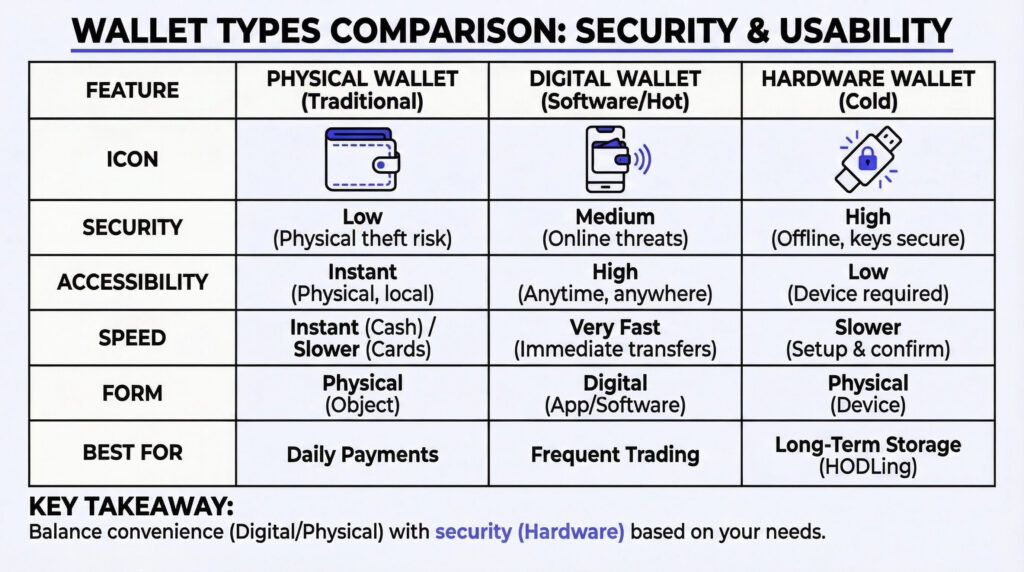
Hot Wallets (Software Wallets)
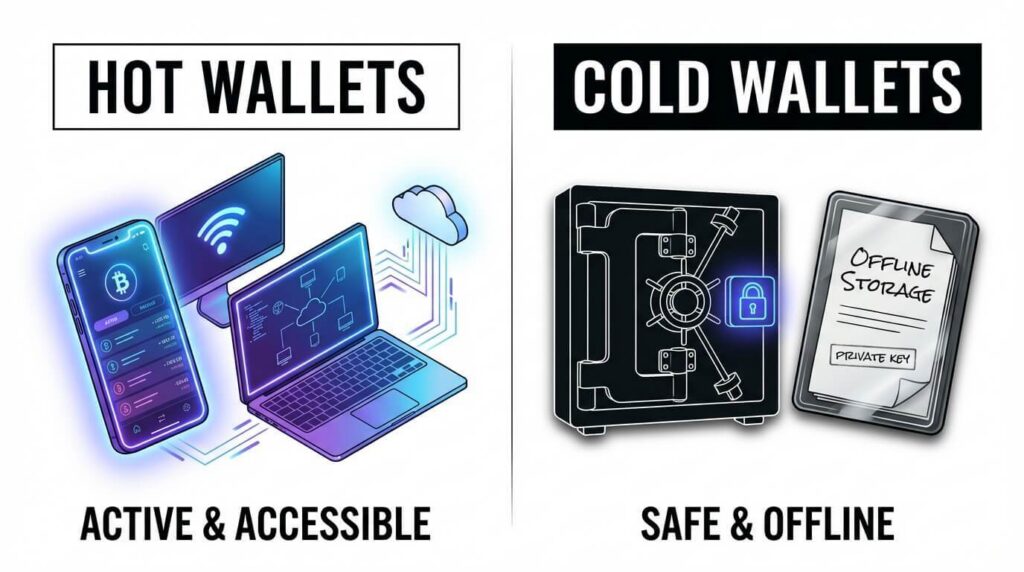
The private keys for hot wallets are kept on machines that are connected to the internet and run software. These wallets let users quickly view, send, and receive cryptocurrencies. They come in the form of mobile apps, desktop programs, and browser extensions. Their main benefit is that they are convenient—you can get your money right away, and they’re usually easy to use.
Hot wallets can be used for everyday transactions and busy trading. But since they are always online, they are more likely to be hit by security threats like malware or illegal access. Users should use strong passwords and security tools like two-factor authentication to lower their risk.
Cold Wallets (Hardware, Paper Wallets)
Cold wallets are intended to keep private keys entirely offline, significantly reducing exposure to cyber threats. A hardware wallet is a special kind of physical device that keeps keys safe, away from computers and networks. They are highly recommended for storing cryptocurrency for a long time and for keeping larger amounts of it.
Paper wallets, on the other hand, are actual copies of a person’s keys. Paper wallets are cheap and can’t be hacked online, but they need to be kept safely and can get lost or ruined if kept unsafely. People who want to keep their money as safe as possible usually choose cold wallets.
Custodial vs Non-Custodial Wallets
This setup makes it easier to use wallets and get back into accounts, but it also puts all the trust in the provider. Non-custodial wallets, on the other hand, give all power and duty to the user, who is responsible for keeping their private keys safe on their own. Non-custodial wallets give you more privacy and freedom, but if you lose the keys to your wallet, you usually lose access to your money and can’t get it back.
Can You Have Multiple Crypto Wallets?
Having multiple bitcoin wallets is not only acceptable in real life, but also expected of anyone who takes digital assets seriously. If you have more than a few small crypto deals, you need to divide your holdings into different groups.
Why? Real-life experience demonstrates that consolidating all your assets into a single wallet exposes you to unnecessary risks. Without a structural split between holdings, a single lost private key, an attack by malware, or even a mistake made by a person can have effects that can’t be undone.
Investors and big players in the market never depend on just one wallet structure. Instead, they use layered wallet strategies, which include cold storage for their main reserves, separate “hot wallets” for operations, dedicated wallets for trying new protocols, and separate addresses for reporting compliance. This method isn’t about making things easier; it’s about being strong and in charge. The design of each wallet is based on threat models, audit requirements, and improving workflow. Each wallet plays a unique part in the overall security architecture.
Is It Legal to Have Multiple Crypto Wallets?
There are almost never limits based on law. Since a wallet is just a pair of cryptographic keys, nobody limits the number of wallets. When it comes to filing, stopping money laundering, and taxes, regulations do come into play, requiring individuals and organizations to adhere to specific reporting standards and practices to ensure compliance with financial laws. How well they record and keep track of their work is what separates professionals from amateurs.
Institutional custodians and funds, for instance, will keep records of every wallet, keep track of all asset flows, and keep logs for internal checks and regulatory reviews. When you don’t do this, even when you’re doing something acceptable, it often leads to problems or scrutiny.
The lesson is the same for private people with bigger holdings: the risk is not having too many wallets but mismanaging them—losing track, forgetting to record transactions, or failing to plan for backups and heirs.
How Many Crypto Wallets Can a Person Have?
The answer varies depending on the level of risk you are willing to take, the complexity of your operations, and the frequency of reporting required.
As a general rule, professionals will have at least three wallets: one for long-term storage (air-gapped, hardware-protected, and multisig if possible), one for everyday tasks, and one or more for new projects or activities with a lot of risk.
If you have ten or more wallets, you need a reliable way to name, track, and check them. The number is less important than your ability to stay aware and in control.
Why Would You Need Multiple Crypto Wallets?
How Multiple Wallets Protect Your Security and Privacy
Using more than one cryptocurrency wallet can make your security and privacy much better. Users can lessen the effects of a single point of failure by putting assets in different wallets. There is limited risk to the assets in one wallet if it is stolen. The funds in other wallets will not be affected. This method also lets you keep your valuable assets in a safer place, like a hardware wallet that is kept offline, while using different wallets for everyday activities. Managing money through separate wallets also makes it harder for outsiders to see all of a person’s wealth and activity. Such an arrangement can be a good privacy measure for people who are worried about their digital footprint or being watched.
Spreading your money out among different wallets lowers your risk
Having more than one crypto wallet can help you diversify your holdings and control your risk. Users can keep funds separate for different platforms, goals, or risk profiles by putting assets in different wallets. For instance, long-term holdings can be kept in a very safe wallet that doesn’t get much exposure to the public, while more active or experimental transactions are done in a different wallet. This split makes it less likely that the whole account will be lost if there is a technical glitch, security breach, or other unplanned event that affects a single wallet or platform. It also lets users spread their risk across different blockchain networks and wallet providers, making them even less reliant on a single solution.
Keeping Your Crypto Organized With Purpose-Built Wallets
Managing digital assets across multiple wallets makes things more organized and makes it easier to keep track of money. Users can more accurately track the movement of assets by setting aside different wallets for different activities, like daily buying, long-term savings, or taking part in decentralized finance. This separation makes it easier to keep records, track performance, balance books, and prepare paperwork for tax or accounting purposes. Keeping track of your wallets in an organized way can also help you avoid making mistakes or losing your money, since each wallet has a specific job to do in the bigger picture.
How to Decide How Many Crypto Wallets You Need
The number of crypto wallets you need depends on your goals, risk tolerance, and involvement with digital assets. There isn’t a single right way to do it. The best way depends on the user’s habits, the complexity of their portfolio, and how much power they want. People who are new to cryptocurrency might want to start with a single wallet that is simple to use and keep track of. As their needs change, they can add more wallets.
A multi-wallet approach is often better for more experienced users, especially those who trade, use decentralized finance, or diversify their assets. Keeping different wallets for different types of funds helps you better control risk, keep track of things, and protect your privacy. A more complicated setup is likely to be needed by users who hold large amounts of money, deal with multiple blockchain networks, or need separate wallets for business and personal use.
To determine how many wallets you need, consider which tasks require separate management, how much risk you’re willing to take with each part of your portfolio, and how much effort you’re willing to put into keeping everything organized and safe. It’s important to do regular reviews because both users’ wants and the cryptocurrency world can change over time.
Typical Wallet Setups by User Type
The following table shows how common wallets are set up based on user experience, security needs, and everyday use. Even though each user has different needs, these setups are generally thought to be the best in the crypto environment.
User Type
Main Wallet Type(s)
Purpose / Activity
Security Level
Notes
Beginner
Software Wallet
Basic storage, sending, receiving
Standard
Simple to use, easy recovery
Advanced User
Software + Hardware Wallets
Trading, DeFi, protocol interaction
Higher
Multiple wallets for different activities
Long-term Investor
Hardware Wallet (Cold Storage)
Long-term holding, occasional transfers
Maximum
Offline storage for the largest balances
DeFi & NFT Enthusiast
Multiple Software Wallets
Staking, NFT management, and liquidity providing
Variable
Separate wallets per protocol or collection
Best Practices for Managing Multiple Crypto Wallets
How to Set Up Multiple Wallets Safely
When you set up multiple crypto wallets, you need to be very careful about security right from the start. Establish each wallet in a secure location, ideally on a device that receives regular updates and is free from malware. Users shouldn’t get wallet software from sources that aren’t official, and they should always make sure that the apps and browser extensions they download are real. Setting up hardware wallets or “air-gapped” devices for long-term storage can help protect you from online dangers. During setup, private keys or recovery phrases should be backed up immediately and stored in a way that only the owner can access.
Categorize and Label Your Wallets
As the number of wallets grows, it’s important to keep them all in order. Giving each wallet a clear goal, like selling, saving, participating in decentralized finance, or managing NFTs, helps you keep track of your digital assets and lowers the chance of getting confused. Labeling wallets in software interfaces and keeping a private log or list of wallet addresses and what they’re supposed to do makes both daily tasks and long-term recordkeeping easier. Putting things into categories that make sense also helps with keeping track of performance and security, since the way each wallet is used can be changed based on its risk and exposure level, such as by categorizing wallets for high-risk trading versus low-risk savings.
Backup and Secure Recovery Phrases
It is important to protect access to every crypto wallet by backing up recovery words and private keys. If your device breaks, you delete something by accident, or you lose your login information, you won’t lose your assets if you have a reliable backup. The recovery phrase for each wallet should be kept in a safe and reliable place, like a safe deposit box, a real safe, or a backup device. If you use digital backups, they need to be encrypted and kept away. Recovery phrases shouldn’t be stored in easily accessible digital formats, like cloud storage or plain text files on internet-connected devices, as they can be accessed by unauthorized users. Checking files often to ensure they are complete and usable further lowers the risk of losing irrecoverable assets.
Use Trusted Devices and Secure Networks
The devices and networks used to access each wallet directly influence its security. Wallet operations, such as generating addresses, signing transactions, or making backups, should be performed only on devices that are regularly updated and free from malicious software. Avoiding the use of public or unsecured Wi-Fi networks is crucial, as these environments increase the risk of interception or unauthorized access to sensitive data. When possible, dedicate specific devices to wallet management, limiting their exposure to unnecessary applications or web browsing. Establishing strong, unique passwords and enabling additional authentication methods further enhances device security and reduces potential vulnerabilities.
Monitor and Audit Wallets Regularly
Effective wallet management requires ongoing oversight, especially when assets span multiple addresses and platforms. Regularly reviewing wallet balances, transaction histories, and recent activity can help identify unauthorized access, mistakes, or discrepancies early. Periodic audits also ensure that all wallets remain active, accessible, and in use as intended, reducing the chance of forgetting or neglecting funds. In addition to checking balances, reviewing backup procedures, and updating security settings as needed, it helps maintain resilience against evolving threats. Staying vigilant with routine monitoring preserves both the integrity and the value of the crypto portfolio over time.
Recommended Tools and Apps for Wallet Management
Managing several crypto wallets efficiently often requires the use of specialized tools and applications designed to simplify oversight and reduce manual effort. Portfolio tracking apps can aggregate balances and transactions from multiple wallets, providing a consolidated view of holdings and performance.
Some platforms allow users to set up notifications for incoming or outgoing transactions, track asset values in real time, and generate reports for tax or accounting purposes. When selecting wallet management tools, it is important to prioritize solutions with a strong reputation for security, transparent privacy practices, and compatibility with the specific wallets and blockchains in use. Choosing well-maintained software helps users maintain both convenience and safety as their digital asset portfolio grows.
How to Keep Track of Multiple Crypto Wallets
Use Portfolio Trackers and Aggregators
Portfolio tracking tools and aggregators provide a streamlined way to monitor balances and activity across multiple wallets and blockchain networks. These platforms consolidate information from various wallets into a single interface, enabling users to view their total holdings, recent transactions, and asset allocation without logging in and out of separate applications. Many portfolio trackers support real-time updates and offer additional features, such as performance analytics and automated alerts. Choosing a reputable, security-focused tracking solution helps maintain an accurate overview of assets while minimizing manual effort.
Keep an Updated Wallet Inventory/Spreadsheet
Maintaining a detailed and regularly updated record of all wallet addresses, along with their designated purposes, is a critical aspect of effective asset management. This inventory can be kept as a securely stored digital spreadsheet or as a physical logbook. By documenting key information, such as wallet type, usage category, backup location, and date of last access, users reduce the risk of forgetting important details or misplacing funds. Consistent record-keeping also simplifies portfolio review, supports tax reporting, and provides a reliable reference in case of technical issues or device loss.
Set Reminders for Check-Ins
Establishing regular check-ins helps ensure that all wallets remain accessible, secure, and up-to-date. Setting periodic reminders to review balances, confirm backup accessibility, and verify that no unauthorized transactions have occurred can prevent small issues from becoming significant problems. These reviews also provide an opportunity to update passwords, enable new security features, and reassess the need for each wallet in the broader portfolio. A disciplined routine of scheduled check-ins supports long-term asset protection and ensures management practices remain aligned with evolving needs.
Managing Taxes with Multiple Crypto Wallets
Tracking Transactions for Tax Purposes
Accurate tax reporting for cryptocurrencies relies on maintaining detailed records of all transactions, including trades, transfers, income, and expenditures. Maintaining comprehensive records becomes even more crucial when distributing assets across multiple wallets.
Users should document every movement of funds, including deposits, withdrawals, swaps, and conversions, along with relevant details such as dates, amounts, counterparties, and any associated fees. This documentation supports both annual tax filings and future audits, clarifying the origin and destination of each asset. A disciplined approach to tracking not only ensures compliance but also reduces the risk of errors or omissions that could result in penalties.
Recommended Tax Tools and Services
To simplify tax management, various software solutions and professional services are available that can aggregate transaction data from multiple wallets and exchanges, streamlining the process. These tools automatically import transaction histories, calculate gains and losses, and generate tax reports in accordance with local regulations.
Choosing a reputable tax platform that supports the specific blockchains and wallet types in use can streamline the entire process and reduce manual workload. For complex portfolios or when navigating unclear regulatory environments, consulting a tax professional with experience in cryptocurrency is advisable to ensure both accuracy and legal compliance.
FAQ
What’s the Proper Way to Decommission or Retire a Crypto Wallet Securely?
Retiring a crypto wallet must be done carefully to prevent unauthorized access or data leakage. First, transfer all assets from the wallet to a new, secure destination and verify the transactions on the blockchain.
For hardware wallets, perform a full factory reset and inspect the device to ensure all information is wiped. Please ensure that any written recovery phrases or seed backups are thoroughly destroyed rather than discarded intact.
For software or browser-based wallets, uninstall the application and delete all related files and backups. If you manage crypto for tax or audit purposes, document the date, reason, and confirmation of deactivation for future reference.
Is it Safer to Use Separate Wallets for Ethereum, Bitcoin, and Layer 2 Networks?
Yes, separating wallets by network reduces the risk of user errors and improves overall security. Using a single multi-chain wallet may be convenient, but it’s more susceptible to mistakes like sending assets to the wrong chain, which can result in permanent loss of funds if the assets cannot be recovered.
Creating dedicated wallets for each network (e.g., Ethereum, Bitcoin, Arbitrum, Polygon) allows for better control, cleaner organization, and fewer technical issues. It’s also a good idea to separate wallets based on use cases, such as trading, staking, and long-term storage.
How can Families or Teams Securely Manage Shared Crypto Wallet Access?
Sharing private keys or seed phrases is never recommended. Instead, use multi-signature wallets that require approvals from multiple participants to authorize a transaction.
Solutions like Gnosis Safe offer role-based access controls, transaction approvals, and detailed activity logs. Establish written access policies, define who can propose or approve transactions, and regularly review these settings as roles change.
Regular testing of recovery procedures is also essential to ensure everyone understands their responsibilities in case of an emergency.
How Can I Confirm that a Crypto Wallet App or Hardware Device is Authentic and Safe to Use?
Only download wallet applications from verified sources, such as official websites or trusted app stores. If available, verify digital signatures or hash values to confirm file integrity.
When purchasing hardware wallets, buy directly from the manufacturer or an authorized distributor. Check for tamper-evident seals and update firmware immediately upon first use using official channels.
Avoid second-hand devices from third-party marketplaces, as these carry a higher risk of being pre-configured or compromised.
Are There Insurance Options for Crypto Stored in Self-Custody Wallets?
Yes, though options are limited and typically geared toward institutional users and high-net-worth individuals. Some insurers offer coverage for theft or loss of crypto stored in hardware wallets, but policies often require strict security protocols, documented procedures, and third-party audits.
For individual users, the best protection remains sound operational security—offline storage, regular backups, and controlled access.
What Should I Do Immediately if My Crypto Wallet Is Hacked or Compromised?
Act quickly if you suspect a wallet breach. Begin by transferring any remaining funds to a new, uncompromised wallet created on a secure device. Then:
Review transaction history for unauthorized activity.
Revoke access or approvals granted to external applications.
Change all related passwords and review device security.
Destroy any exposed seed phrases or private keys.
Document the incident in detail, especially for compliance or legal purposes.
For business or high-value accounts, an incident response plan should already be in place and tested regularly.
Cryptocurrency scams are deceptive schemes that use the features of cryptocurrencies, such as their anonymity, lack of centralization, and ability to do transactions that can’t be undone, to steal money from people or businesses. These scams are different from regular financial fraud because they use digital wallets, blockchain transactions, and crypto exchanges, which makes it harder to find and get your money back.
Scammers can fool both new and experienced investors by making false promises, pretending to be someone else, or messing with technology. Cryptocurrencies work outside of established banks and other financial institutions, so victims usually don’t have many options after they’ve sent money.
Why Crypto Is a Popular Target for Scammers
Here are some of the reasons why scammers like cryptocurrencies:
Lack of Regulation: A lot of crypto marketplaces are in places where there aren’t many rules or none at all.
Anonymity and Pseudonymity: Even though blockchain transactions are public, wallet addresses often keep users’ real names secret.
High Public Interest: The rapid rise in the popularity of cryptocurrencies draws in a lot of people who don’t know much about how they work or how to spot common scams.
Because of all the new technology and ways to make money, this is a great place for fraud to happen.
Key Differences Between Crypto Scams and Traditional Scams
Feature
Traditional Scam
Crypto Scam
Payment Method
Bank transfers, credit cards
Cryptocurrency (Bitcoin, Ethereum)
Traceability
Easier to trace
Harder to trace due to decentralization
Legal Protections
Often available
Usually absent
Refund Possibility
Sometimes
Rare to impossible
Common Platforms
Phone, email, websites
Social media, exchanges, and wallet apps
Crypto scams often get past regular fraud detection systems because they use people’s inexperience, the platform’s complexity, and the need to act quickly.
How to Tell If a Crypto Scam Is Happening
Most of the time, cryptocurrency scams don’t start with obvious technical attacks. They often start with small changes in behavior that play on how people think. You need to stop thinking about the scam itself and start thinking about the tricks used to get people to fall for it in order to read these early warning signs. This section talks about how scammers use communication and emotion to get people to do things without thinking about it, often before the victim knows what’s going on.
Signs that someone is trying to commit fraud
Getting a message, email, or call from someone you don’t know without having talked to them first is one of the most common warning signs. Most of the time, these messages are about a problem that seems urgent or an opportunity that seems too good to pass up. Scammers know that when people are under a lot of stress, they are more likely to do things that don’t make sense. To get people to act quickly, they offer deals that are only available for a short time, say that accounts have been hacked, or say that money is at risk unless action is taken right away.
Another sign that something is wrong is when someone promises guaranteed returns, which are often hidden behind “exclusive” investment options. No real investment can give you that level of confidence in the world of crypto, which is always changing. You should be wary right away if returns sound like they are guaranteed, quick, and safe.
Scammers also depend on keeping things secret. People who have been hurt are often told not to talk to anyone else about the problem, either directly or in a way that isn’t obvious. This way of separating people makes it impossible to check facts and gives the impression that there is an urgent need for privacy, all of which are meant to make it harder to make good choices.
Emotional and Cognitive Manipulation
These strategies might seem complicated at first, but they work best because they play on people’s emotional weaknesses. People are skillfully made to ignore their own judgment by using fear, excitement, and trust.
For example, you might get a fake message saying that your wallet has been hacked and telling you to check it “urgently.” In other cases, you might be told that you are eligible for a special investment opportunity or giveaway that is only available for a short time. These stories aren’t just random. They are meant to keep you from doing due diligence.
Trust is another important part. To get people to trust them, messages sometimes look and sound like they come from well-known people or businesses. Even though these attempts don’t always involve full impersonation, they use familiarity and perceived authority to lower your guard.
In the end, you should be very careful in any situation that tries to control how quickly you make a decision, limit how much other input you can get, or make you feel like you have to act right away. Scammers don’t win because they are smarter than other people; they win because they outpace their ability to think critically in the moment.
How to Protect Yourself from Being Scammed with Cryptocurrency
How to Improve Your Digital Security
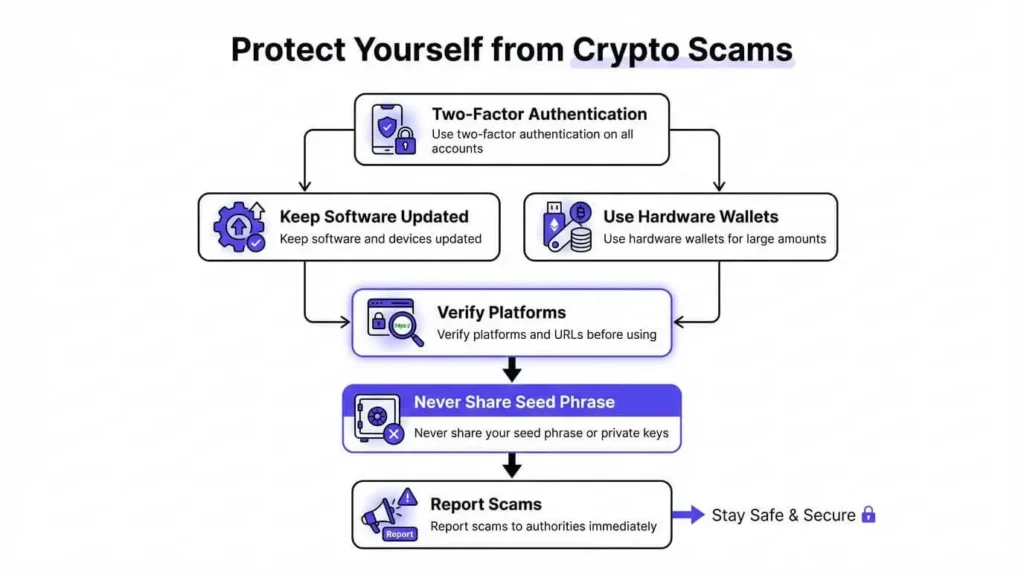
The first step in keeping yourself safe from cryptocurrency scams is to practice good digital hygiene. This means that you should protect all of your accounts by using complex, unique passwords and two-factor authentication (2FA). To make devices safer, they should always have the latest software versions installed. Don’t download apps, browser extensions, or pirated software that you don’t know are safe. These are common ways for malware and spyware to get into crypto wallets.
A hardware wallet, also known as cold storage, is the best way to keep significant amounts of cryptocurrency safe. Cold wallets, unlike hot wallets, keep assets offline, which makes them less likely to be hacked. On the other hand, hot wallets are linked to the internet.
Recognizing Safe Platforms
One important way to lower risk is to use platforms that you can trust. Most of the time, people trust exchanges and wallet providers that are registered with financial supervision agencies and keep excellent records of how they do business. They will be very honest about their security measures, management teams, and connections to regulators. When you get to a site through social media or search engines, it’s very important to check the official domains. This is because some phishing schemes use fake websites that look like real ones.
Users should save official URLs as bookmarks and not click on login pages that come from emails, texts, or ads that they didn’t ask for. If you’re still not sure, you can feel better by looking up platform information on public aggregators like CoinMarketCap or CoinGecko.
How to Handle Seed Phrases and Private Keys
The seed phrase, also known as a recovery phrase or mnemonic phrase, is the most important thing to keep your digital currency safe. It gives full access to the wallet that comes with it, which means it also gives access to the funds that it holds. It needs to be protected like financial information or sensitive paperwork because of this.
You should never tell anyone this phrase, no matter what the reason or the situation. No real wallet provider, exchange, or support person will ever ask for it. Even if you don’t mean to, sharing it puts the whole wallet in danger.
The safest way to save a seed phrase is to do it offline. Writing it down and putting it in a safe, fireproof place is the best thing to do. On the other hand, storing it in emails, screenshots, cloud storage, or any device that is connected to the internet makes it even more dangerous. You can’t get back in if you lose access to your wallet without the seed phrase. This means that managing safety is not only important, but also necessary.
Critical Thinking and Verification
Scammers rely on speed and distraction. If you take the time to look at a website, make sure a contact is who they say they are, or look into an investment opportunity, you can avoid losing money that you can’t get back. People don’t usually feel like they have to do something right away when they get an official message.
Before you do anything with the funds, it’s a good idea to look into the project’s leaders, read its history, and read any technical papers (like a white paper). People’s comments on trustworthy forums and watchdog sites can also show patterns of fraud or strange behavior.
What to Do If You Get Scammed
No matter how hard they try, even careful people can fall for cryptocurrency scams. It is hard to recover cryptocurrency from blockchain because it is decentralized, but acting quickly and with knowledge can limit future harm, help with investigations, and keep other people from having the same problems.
Immediate Steps to Take
Get any funds that are still available as soon as possible. If the scam involved a hacked wallet or account, move the money to a safe wallet that isn’t connected to the scam. Change all of your passwords, especially those that are linked to email accounts, exchanges, or mobile devices.
Next, write down everything that happens. Keep any screenshots, emails, wallet addresses, and transaction IDs that have to do with the event. If you decide to file a formal complaint with the police or a financial platform, this proof will be very helpful.
You should also let your cryptocurrency wallet provider or exchange know. Most crypto transactions can’t be undone, but if you send in the report quickly, some platforms might be able to freeze assets or flag accounts that look suspicious.
Where to Report Crypto Scams
In the United States and other places, a number of agencies will take complaints about cryptocurrency fraud. Victims should report the incident to:
Victims can also interact with cybersecurity groups that keep blacklists or warning systems for crypto users about fake wallet addresses or phishing sites.
Reporting fraud not only helps with investigations, but it also helps regulators understand how wrongdoing happens on different platforms.
Considering the legal and tax effects
Some losses from bitcoin fraud may be eligible for different kinds of tax relief, depending on where you live and what kind of loss it is. You should talk to a tax expert to see if you can claim a loss and how to do it.
Some victims may also file civil lawsuits, but these are usually not successful because it is hard to find and identify the criminals in anonymous blockchain transactions.
Psychological and Community Support
It can be very upsetting to get scammed. A lot of the time, people are too embarrassed or angry to ask for help. But being honest about the problem and telling others about it can help them stay out of the same situation.
Joining trustworthy crypto communities, advocacy groups, or consumer protection groups can also help and keep you up to date on the latest issues.
Common Types of Cryptocurrency Scams
There are many different kinds of cryptocurrency scams, and they change all the time as new technologies and market trends come out. Most scams fall into certain groups, even though the ways they are carried out may be different. You need to know how these scams work in order to avoid them.
Phishing Scams
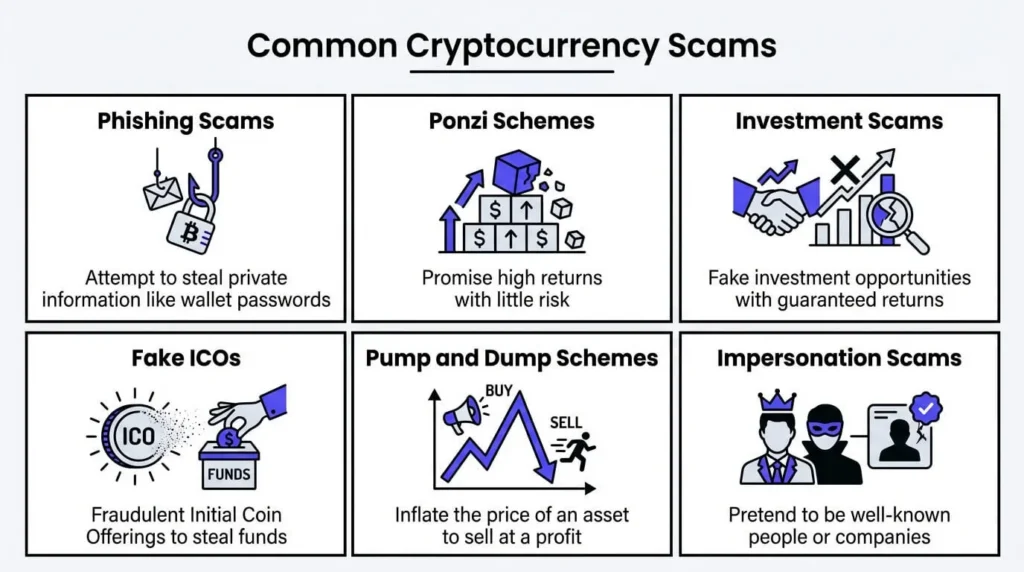
Phishing scams try to get people to give up private information, like the passwords to their wallets. Attackers may set up fake exchanges or wallets that look like real ones and trick people into giving them their login information. Some people use email, chat apps, or social media to act like customer service. The goal is to get into wallets and move money without permission.
Investment and Ponzi Schemes
These scams promise returns that are much higher than normal with little to no risk. Most of the time, the plans depend on paying people who join early with money from new recruits. In most places, this is not a legal way to make money. People who promote scams may say they have inside information or use fake success stories and testimonials to get people to fall for them.
Impersonation Scams
Scammers often act like famous people, crypto influencers, CEOs, or people who work for companies that people trust. They might create fake social media profiles or use fake screenshots to make themselves look real. People who have been scammed are often told to send cryptocurrencies with the promise of getting more back or to take advantage of an “exclusive” investment chance.
Rug Pulls and Exit Scams
A rug pull happens when the people who started a project suddenly stop working on it or take all the money they raised from investors. These scams happen a lot in decentralized finance (DeFi) and usually involve fake coins, fake whitepapers, and aggressive advertising. When people put money into the project, it shuts down, and most of the time, there is no way to find out who did it.
Airdrop and Giveaway Scams
Fake giveaways often promise people free cryptocurrency if they first send a small amount of money to a specific wallet. In real life, there is no return. Legitimate airdrops never ask users for money, private keys, or access to their wallets. These scams usually work by making people feel like they need to act fast, and they are spread through fake or hacked social media accounts.
Fake ICOs (Initial Coin Offerings)
Scammers might set up fake ICOs that look like real cryptocurrency fundraising campaigns. People are asked to put money into a project that seems like it will be successful, but once the money is collected, the developers vanish. These plans often include professionally designed websites and whitepapers, but they don’t have any technical information or team members that you can recognize.
Malware and Remote Access Tools
Some hackers use malware to gain access to a user’s device without their knowledge. This includes keyloggers, clipboard hijackers, and programs that look for wallet files. Some people tell victims to install remote desktop software while pretending to help them with tech problems. Once someone has access, they can take money right out of the wallet or exchange.
Romance and Social Engineering Scams
Most of the time, romance scams start on dating sites or social media. After they have gained your trust, the scammer will either ask for money for something important or offer you an investment opportunity related to digital currencies. These scams prey on people’s emotional weakness and can last for weeks or even months before they ask for money.
Fake Job Offers and Employment Scams
Fake job offers may be sent to people who work as crypto traders, exchange affiliates, or payment processors. Victims are often asked to pay fees or send bitcoin ahead of time as part of the “onboarding” process. In some cases, fake checks are sent to victims, who are then told to use that money to buy bitcoin. However, the checks turn out to be fake.
Blackmail and Extortion
Scammers often say they have sensitive information or hacked data and ask for cryptocurrencies to keep it from getting out. Most of the time, people send the texts to big groups and don’t include any specific information. A lot of them are just empty threats, but some of them might have stolen data from other breaches that have nothing to do with the threat. Experts say you shouldn’t pay and should instead report the cybercrime to the authorities.
Legal and Regulatory Considerations
The law is still trying to figure out how to handle scams involving the virtual currency. It is hard for national and international regulators to protect people and go after fraud because blockchain technology is decentralized and has no borders. Still, legal systems are starting to come together, which gives people both ways to protect themselves and ways to get help.
Regulatory Authorities and Jurisdiction
In numerous jurisdictions, different government agencies watch over various aspects of cryptocurrency activity. In the United States, the Securities and Exchange Commission (SEC), the Commodity Futures Trading Commission (CFTC), and the Financial Crimes Enforcement Network (FinCEN) all perform distinct tasks. These jobs depend on whether the asset is a commodity, a security, or subject to laws against money laundering.
Countries have done things in various manners. For instance, the European Union’s Markets in Crypto-Assets Regulation (MiCA) attempts to ensure that all member states follow the same rules. Japan, Singapore, and Switzerland have also made rules for licensing bitcoin exchanges and custodians at the same time.
Even with these changes, enforcement is often hindered because many transactions are anonymous, privacy coins are used, and offshore platforms are common.
Classification of Crypto Assets
The way a cryptocurrency is classified can have a big impact on how well it is protected by the law. Some countries see crypto tokens as securities, which means they have to follow the rules for registration and disclosure in those countries. Some people might think of them as digital property, ways to pay, or even goods.
This lack of clarity can make it harder for investors to protect themselves and for authorities to go after fraudsters. For example, if an asset is not legally defined as a security, some rules that protect consumers may not apply to it.
Consumer Protections and Limitations
Two examples of traditional financial protections that don’t usually apply to cryptocurrency transactions are deposit insurance and chargeback rights. You can’t change a transaction once it’s been sent out and confirmed on the blockchain. This means that it is up to each participant to keep their private keys safe and make sure that the people they are dealing with are who they say they are.
Some exchanges and wallet providers have created their own fraud departments and ways to settle disputes, but these are not required and don’t always work well. In some cases of fraud, you may be able to get legal help, but you usually have to find the person who did it, which can be hard or impossible if you can’t issue a subpoena or work with other countries.
Issues with Prosecution and Enforcement
Law enforcement is paying more and more attention to big cryptocurrency schemes, especially those that involve money laundering, investment fraud, and unregistered securities. You need clear proof, the right jurisdiction, and the right technical tools to win a case, though.
It’s still hard to work together across borders. Scammers usually work in countries that don’t have treaties that let them send criminals back to their home countries or official ways to deal with cybercrime. The rise of anonymizing technologies and decentralized platforms has also made digital forensics and asset recovery more difficult.
Emerging Legal Trends
As scams get more complicated, lawmakers and regulators are coming up with new ways to keep an eye on them and stop them. Here are some of them:
Mandatory Know Your Customer (KYC) and Anti-Money Laundering (AML) compliance for exchanges and service providers
Licensing requirements for crypto custodians and platforms
Greater transparency around initial coin offerings (ICOs) and tokenized assets
The development of centralized reporting systems for fraud
Some jurisdictions are also exploring victim compensation funds or insurance mechanisms, though such initiatives remain in early stages.
FAQ
Can I get my cryptocurrency transactions back if I was scammed?
No. After a transaction is confirmed on the blockchain, it is added to a ledger that cannot be changed or undone. This is true for both real and fake transfers. Centralized platforms may be able to help in very rare cases if they are told right away, but there is no official way to cancel transactions.
How can I tell if a crypto platform is regulated?
Check to see if the platform is licensed or registered with a national financial organization. Many good websites have their license numbers and the jurisdictions where they can do business in the footer. You can find out more about this by looking at official government databases or directories of independent regulators. Be careful if there is no mention of a license at all.
Are all unsolicited crypto investment offers scams?
Not every offer is a scam, but you should be careful if someone you don’t know tries to get you to invest without asking. This is how most scams begin. Don’t do it if you didn’t ask for it. That’s a good rule of thumb. Take some time to learn more about it and get other people’s opinions before you get involved.
Are crypto giveaways on social media legitimate?
There are real giveaways, but you never have to pay to enter. Scammers often use the format to make fake endorsements or copy profiles. Don’t just believe what you read in a post. Always check the company’s official website or a verified social media account for free stuff.
Can I report a crypto scam if I live outside the U.S.?
Yes. Most governments have teams that deal with cybercrime or financial watchdogs that look into fraud involving cryptocurrencies. You can also report cases to websites like Chainabuse.com or international groups like INTERPOL and Europol. Reporting helps make people more aware of the law and enforce it around the world, even if the money can’t be found.
How do I secure my wallet against remote access attacks?
Use hardware (cold) wallets to store your coins for a long time, and make sure that two-factor authentication is turned on for all of your exchange accounts. Don’t install software or browser add-ons that you don’t know about. You should never type your recovery phrase into a device that is connected to the internet unless you are restoring a wallet from a trusted app. Always keep it off the internet.
Bitcoin is a decentralized digital currency that operates independently of central authorities or financial institutions. Since its launch in 2009, it has become a widely discussed technological and economic innovation, attracting attention for both its potential uses and the security concerns surrounding its infrastructure and usage.
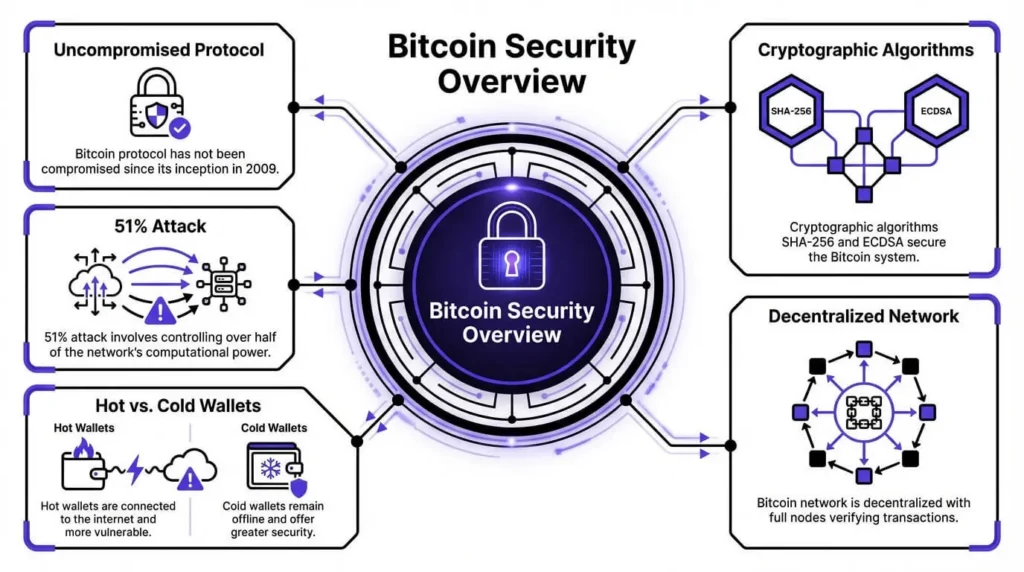
Although the Bitcoin protocol has not been compromised since its inception, the broader cryptocurrency ecosystem has experienced numerous security incidents. Attacks on exchanges, wallets, and users have resulted in substantial financial losses, raising ongoing concerns about the overall safety of holding and transacting in Bitcoin.
Security in the context of Bitcoin involves both the robustness of the network itself and the practices of individual users. While the core blockchain is secured through cryptographic and decentralized mechanisms, vulnerabilities often arise in the interfaces through which users access and manage their funds.
Understanding Bitcoin’s Security Model
The Role of Decentralization
Each full node within the Bitcoin network stores a complete history of all transactions and participates in verifying new blocks. Because no single entity controls the network, altering the blockchain requires compromising a majority of the network’s computational power, a condition known as a 51% attack. Given the scale of the network, such an attack is considered technically and economically unfeasible.
Decentralization also enhances the network’s resilience. Even if a subset of nodes becomes unreachable due to localized disruptions, the remaining nodes can continue to operate without compromising data integrity or consensus.
Cryptographic Foundations of the Bitcoin Protocol
Bitcoin uses two principal cryptographic algorithms to secure its system: SHA-256 and ECDSA. SHA-256 supports the Proof of Work mechanism, which requires miners to expend significant computational effort to append new blocks to the blockchain. This process deters tampering by making it costly to alter historical data.
ECDSA (Elliptic Curve Digital Signature Algorithm) is employed to verify ownership of Bitcoins. Transactions must be signed with a private key corresponding to the sender’s address. Because only the holder of the private key can generate a valid signature, this mechanism effectively prevents unauthorized spending.
These cryptographic standards are widely used in digital security and have not been broken with current methods, providing a high level of assurance for the integrity of the Bitcoin protocol.
What Makes the Bitcoin Blockchain Tamper-Resistant?
The Bitcoin blockchain is structured as a linear sequence of blocks, each containing a cryptographic hash of the block that precedes it. This structure links all blocks in chronological order, forming an immutable chain of blocks. Modifying the contents of any one block would necessitate re-mining all subsequent blocks, which requires more computational power than the rest of the network combined.
In addition to technical safeguards, the network enforces consensus rules that reject any blocks that deviate from established protocol parameters. These rules help maintain uniformity and accuracy across all participating nodes, making the blockchain resistant to unauthorized alterations.
The Difference Between Network and User Security
Security within the Bitcoin ecosystem can be broadly divided into two distinct domains: the integrity of the Bitcoin network itself and the security practices of individual users. While the protocol has demonstrated strong resilience against technical compromise, users remain exposed to a range of risks primarily stemming from operational behavior, software vulnerabilities, and third-party services.
Bitcoin Network Security Explained
The Bitcoin network is protected through a distributed consensus mechanism known as Proof of Work. This system requires participants (miners) to solve complex mathematical problems to validate transactions and add them to the blockchain. These validations are continuously performed by thousands of nodes worldwide, ensuring that no single party can gain control over the ledger without a majority share of computational power.
This consensus-based structure prevents double-spending, unauthorized changes to transaction history, and central points of failure. As of now, the Bitcoin blockchain has never been successfully altered or compromised by external attackers. Its architecture is designed to be inherently resilient, with each node independently enforcing the protocol rules and rejecting invalid transactions or blocks.
Additionally, proposed changes to the protocol undergo extensive peer review and require widespread agreement from network participants. This conservative approach to protocol upgrades minimizes the risk of introducing security vulnerabilities.
Common Vulnerabilities in User Behavior
Despite the robustness of the underlying network, many security breaches in the Bitcoin ecosystem originate from human error, poor security hygiene, or reliance on insecure platforms. Users frequently fall victim to phishing attacks, fake wallet applications, and malicious software designed to harvest login credentials or private keys.
Storage practices are a major point of vulnerability. Bitcoin stored on centralized exchanges is susceptible to hacking incidents or insolvency events, as these platforms control the private keys on behalf of their users. The history of cryptocurrency includes several high-profile exchange breaches that have resulted in the loss of user funds.
Lack of two-factor authentication, weak passwords, and failure to update software further contribute to user-side risk. Unlike traditional financial systems, Bitcoin transactions are irreversible; once funds are transferred to an unauthorized address, they cannot be recovered.
The 51% Attack: Can Bitcoin’s Blockchain Be Manipulated?
While the Bitcoin protocol has proven resilient, one theoretical scenario, known as a 51% attack, remains a central concern in discussions about network-level vulnerabilities.
Understanding the 51% Attack Scenario
A commonly discussed theoretical vulnerability is the “51% attack.” This scenario involves a single entity or a coordinated group gaining control of more than half of the total computational power (hash rate) that secures the Bitcoin network. With such a majority, the attacker could attempt to:
Prevent specific users from having their transactions confirmed
However, even with the majority of hash power, the attacker would remain unable to:
Steal bitcoins from other wallets without private key access
Create new coins beyond the protocol’s issuance rules
Rewrite the deep transaction history due to prohibitive computational demands
While disruptive, a 51% attack would not grant the attacker arbitrary control over the network or violate Bitcoin’s core cryptographic principles.
Barriers to a Network Takeover
Executing a 51% attack in practice is highly improbable. The Bitcoin network operates at a global scale with an exceptionally high hash rate, requiring:
Billions of dollars in specialized mining hardware (ASICs)
Access to vast amounts of electricity at low cost
Technical capacity to deploy and maintain infrastructure at scale
Such an operation would also need to be sustained over time to succeed. Meanwhile, the Bitcoin community, including developers, miners, and node operators, would likely respond to the threat through protocol upgrades, soft forks, or the reallocation of mining resources.
Moreover, any perceived compromise could severely impact market confidence, causing the price of bitcoin to drop and devaluing the attacker’s holdings. These factors combine to create a powerful economic disincentive against attempting a takeover.
Incentives That Promote Network Integrity
Bitcoin’s security is reinforced by a system of aligned incentives. Miners receive block rewards and transaction fees for their honest participation, making adherence to the consensus rules more profitable than attempting to attack the network. An adversarial action risks losing these rewards and damaging the long-term viability of their investment.
This alignment of interests between miners, developers, and users supports a self-regulating system. By making malicious behavior economically irrational, Bitcoin’s design promotes the continued integrity of its blockchain.
Securing Bitcoin Wallets and Private Keys
Bitcoin ownership is fundamentally tied to the control of private cryptographic keys. These keys are used to authorize transactions and prove ownership of funds. Unlike traditional banking systems, where identity and recourse mechanisms can assist in recovering lost access, Bitcoin places full responsibility for security on the user. If a private key is lost or compromised, the associated bitcoins cannot be retrieved, making secure key management essential.
Why Private Keys Are Critical and Vulnerable
Private keys serve as the sole means of controlling Bitcoin funds. Whoever possesses the key can transfer the coins, regardless of how they obtained it. This makes private keys both the foundation of Bitcoin’s security model and its most fragile component.
Their vulnerability stems not from flaws in the cryptography but from user behavior and storage practices. Keys stored on internet-connected devices are exposed to malware, keyloggers, and remote-access attacks. If stored in cloud services or unencrypted local files, they become vulnerable to phishing, account breaches, or unauthorized third-party access. To mitigate these risks, best practices recommend using offline storage, securing backups in multiple physical locations, and utilizing dedicated hardware for key management.
Hot vs. Cold Wallets: Pros and Risks
Wallets, tools that store and manage private keys, come in two general categories: hot and cold.
Hot wallets are connected to the internet, making them suitable for frequent transactions but inherently more exposed to online threats. These include desktop, mobile, and browser-based wallets, which are vulnerable to system-level exploits and phishing campaigns.
Cold wallets, on the other hand, remain offline except when they are used to sign transactions. They include hardware wallets, air-gapped computers, and even paper wallets. While offering greater protection from remote attacks, they require careful physical handling and secure backup strategies to prevent loss due to damage, theft, or misplacement.
The trade-off between convenience and security is central to selecting a wallet. Active users may use hot wallets for everyday use while reserving cold wallets for long-term storage.
Custodial vs. Self-Custodial: Who Holds the Keys?
A key distinction in wallet security is whether the user or a third party holds the private keys.
Custodial wallets, typically offered by exchanges or financial platforms, manage users’ keys on their behalf. While convenient and often integrated with trading services, they introduce reliance on the provider’s security infrastructure. If the platform is hacked or becomes insolvent, users risk losing access to their funds.
Self-custodial wallets place the responsibility entirely on the user, who retains full control of their private keys. This approach aligns with Bitcoin’s principle of decentralization but also demands technical understanding and diligence in protecting those keys.
Choosing between custodial and self-custodial solutions depends on the user’s needs, risk tolerance, and willingness to manage their own security.
Phishing, Malware, and Common User Mistakes
Many Bitcoin losses occur not due to flaws in the technology but because of human error and targeted attacks. Common threats include:
Phishing, where malicious actors impersonate legitimate services to steal login credentials or seed phrases.
Malware, such as clipboard hijackers or keyloggers, operates silently to intercept sensitive data.
Insecure backups include storing recovery phrases in cloud storage or plaintext files.
Weak authentication, such as reusing passwords or failing to enable two-factor authentication.
Preventative measures include using hardware wallets, installing antivirus software, maintaining device hygiene, and avoiding unknown links or applications. Users are also encouraged to test backups periodically and educate themselves on current attack vectors.
Is Bitcoin Vulnerable to Emerging Technologies?
Emerging technologies such as quantum computing and advanced artificial intelligence have prompted new discussions about the long-term resilience of blockchain networks. While Bitcoin is currently considered secure against conventional attacks, the development of disruptive technologies could challenge existing assumptions about its invulnerability.
Cryptographic Risks in a Post-Quantum Era
Bitcoin relies heavily on cryptographic algorithms to secure transactions and maintain the integrity of its blockchain. The most critical among these are:
ECDSA (Elliptic Curve Digital Signature Algorithm), used to verify transaction authenticity.
SHA-256, a hash function employed in Bitcoin’s Proof-of-Work consensus.
Both systems are considered secure under classical computing models. However, in a post-quantum context, their robustness becomes uncertain. Quantum computers, if sufficiently advanced, could theoretically break elliptic curve cryptography using Shor’s algorithm, thereby compromising private keys and enabling the unauthorized transfer of funds.
SHA-256 is less directly threatened by quantum algorithms; however, Grover’s algorithm could potentially halve its effective security level, enabling faster brute-force attacks. Nonetheless, achieving the scale of quantum power needed for practical attacks remains, for now, a theoretical concern.
Bitcoin developers and researchers have acknowledged this risk, and proposals have been made to transition the protocol to quantum-resistant signature schemes if the technology becomes a credible threat. Migration, however, would require widespread coordination and may impose significant logistical and computational costs on the network.
The Role of Artificial Intelligence in Bitcoin Security
Artificial intelligence (AI), although not inherently malicious, can be leveraged by attackers targeting the Bitcoin ecosystem to augment their capabilities. It is essential to distinguish between attacks on the Bitcoin network itself and those targeting individual users or the supporting infrastructure. Currently, AI does not pose a direct threat to the Bitcoin protocol; however, it can enhance the sophistication of user-focused attack vectors.
AI-enhanced tools have been employed in:
Phishing and impersonation attacks involve machine learning models generating realistic messages or deepfake content to deceive users.
Behavioral analysis enables attackers to model user habits and identify potential security vulnerabilities.
Malware development enables automated adaptation to different environments and evasion of traditional security software.
Such tools can increase the effectiveness of efforts to obtain private keys, passwords, or other sensitive information. However, AI does not enable attackers to bypass the cryptographic mechanisms that protect the Bitcoin blockchain itself. It cannot reverse SHA-256 hashes, forge ECDSA signatures, or manipulate the consensus process.
The security of the core Bitcoin protocol remains dependent on mathematical hardness assumptions, not on human fallibility. While AI may pose a threat to users who rely on poor security practices or centralized platforms, it does not currently compromise the network’s structural security.
Bitcoin vs. Traditional Financial Systems: A Security Comparison
The security architecture of Bitcoin differs fundamentally from that of conventional financial institutions. Traditional systems, such as banks, payment processors, and credit card networks, operate under centralized control, wherein a single entity or a consortium governs access, security, and transaction processing. These institutions implement layered cybersecurity measures, including encryption, fraud detection algorithms, and regulatory oversight, but remain vulnerable to targeted breaches, insider threats, and single points of failure.
In contrast, Bitcoin relies on decentralized consensus, cryptographic proofs, and a transparent ledger distributed across thousands of nodes worldwide. This decentralized model eliminates central points of control, making systemic compromise significantly more difficult. However, it also shifts the burden of security onto the individual user, particularly regarding the management of private keys and wallet credentials.
Traditional systems offer recourse mechanisms, such as customer support and transaction reversibility, which Bitcoin lacks by design. As a result, while Bitcoin’s core network exhibits a high degree of technical resilience, its user-facing components require a higher level of individual security literacy to match the practical protections offered by traditional finance.
Can Bitcoin Be Shut Down or Censored?
Bitcoin’s decentralized architecture was intentionally designed to resist censorship, control, or shutdown by any single entity. Unlike traditional systems that rely on central servers or authorities, Bitcoin is maintained by a globally distributed network of nodes, each of which independently verifies and relays transactions. This structural redundancy grants the protocol a high level of resilience, making it difficult to suspend or censor the network as a whole.
While local jurisdictions may restrict access to exchanges or criminalize specific uses of cryptocurrencies, the Bitcoin network itself has demonstrated robust resistance to direct interference. Its open-source nature and permissionless participation model enable it to persist even under adverse regulatory or technological conditions.
Network Resilience in the Face of Global Disruptions
For Bitcoin to be completely shut down, global and simultaneous disruptions would be required across the entire network, a scenario that is both technologically and logistically improbable. Each full node maintains a copy of the blockchain and can operate independently. Even if a significant portion of the network were taken offline, the remaining nodes would continue to validate transactions and preserve consensus.
Instances of partial network outages, such as internet blackouts or regional shutdowns, have occurred without impacting the integrity of the broader Bitcoin ledger. This resilience is underpinned by the absence of a single point of failure, as well as the network’s ability to self-heal when disconnected nodes reconnect and resynchronize.
Offline Nodes and Alternative Communication Channels
Bitcoin nodes are not exclusively dependent on traditional internet infrastructure. In regions with restricted access, nodes have been operated using mesh networks, radio waves, and even satellite connections. Blockstream’s satellite network, for example, broadcasts the Bitcoin blockchain to almost every continent, allowing receivers to download blockchain data without requiring internet access.
Such alternative communication methods are crucial for maintaining the network’s accessibility and autonomy, particularly in jurisdictions that attempt to curtail digital financial tools. They also ensure continuity in the event of natural disasters or large-scale network disruptions.
Legal and Political Limitations to Suppressing Bitcoin
Although governments have the power to regulate the use of Bitcoin within their borders by banning exchanges, taxing transactions, or criminalizing unauthorized crypto activity, they cannot directly alter the protocol or forcibly remove it from existence. At most, regulatory pressure can limit adoption or disincentivize participation through legal risk.
However, any attempt at coordinated global suppression would face significant political and logistical hurdles. Bitcoin operates across thousands of independent jurisdictions, many of which view its decentralized nature as a safeguard against economic instability or political interference. Additionally, enforcement of such a ban would likely push Bitcoin use further underground, without eliminating the protocol itself.
How to Protect Your Bitcoin from External Threats
While the Bitcoin protocol itself is considered highly secure, the broader ecosystem, particularly the points where individuals interact with their coins, is susceptible to a range of threats. Phishing attacks, malware, weak credentials, and insecure storage practices have been responsible for the vast majority of Bitcoin losses. As such, user-side security remains a critical component in preserving the integrity of one’s holdings.
Self-Custody Best Practices
Self-custody refers to the practice of maintaining full control over one’s private keys, as opposed to entrusting them to a third party such as a cryptocurrency exchange. This approach aligns with the fundamental philosophy of Bitcoin, which is to eliminate intermediaries in favor of user sovereignty.
To effectively manage self-custody, individuals must ensure their private keys are generated, stored, and accessed securely. Wallet software should be sourced from reputable developers and verified before use. Recovery phrases, commonly used to regenerate wallets, should be written down and stored offline in multiple geographically dispersed locations. These practices reduce the risk of digital theft and ensure recoverability in the event of device failure.
The responsibility of self-custody cannot be overstated. While it offers maximum control, it also entails maximum liability: if the keys are lost or compromised, there is no institutional mechanism for recovering the assets.
Hardware Wallets and Cold Storage Explained
Hardware wallets are physical devices designed to store private keys in an isolated environment securely. These wallets typically remain offline, making them a form of “cold storage”, and only connect to the internet temporarily when signing transactions. Because the private key never leaves the device, even a compromised computer cannot access it.
Popular hardware wallets include devices such as Ledger, Trezor, and Coldcard. Each offers varying features related to usability, compatibility, and physical security. When configured properly, hardware wallets provide one of the most secure methods for storing Bitcoin, particularly for long-term holdings.
Cold storage, more broadly, encompasses any method of keeping private keys offline. In addition to hardware wallets, this category includes air-gapped computers, encrypted USB drives, and even paper wallets. While less convenient for frequent transactions, cold storage significantly reduces the attack surface available to hackers.
Importance of Two-Factor Authentication and Secure Devices
Two-factor authentication (2FA) adds a critical layer of security to Bitcoin wallets and exchange accounts. By requiring a second verification step, typically through a time-sensitive code generated by a separate device or app, 2FA makes unauthorized access substantially more difficult, even if a password is compromised.
For maximum effectiveness, users should avoid SMS-based two-factor authentication (2FA), which is vulnerable to SIM-swapping attacks. Authenticator apps, such as Google Authenticator, or hardware tokens, like YubiKey, are considered more secure alternatives.
In parallel, maintaining device security is essential. Wallet applications should only be installed on devices with updated operating systems and reputable antivirus software. Rooted or jailbroken devices should be avoided entirely, as they undermine the underlying protections offered by modern operating systems. In cases where large sums of Bitcoin are stored, it may be prudent to use a dedicated device for wallet management, disconnected from everyday browsing or applications.
Avoiding Cloud Storage and Common Mistakes
Storing private keys, seed phrases, or wallet backups in cloud services (Google Drive, Dropbox, or iCloud) poses a significant security risk. These platforms, while convenient, are frequent targets for phishing campaigns and credential stuffing attacks. Once accessed, cloud-based wallet information can be used to irreversibly steal funds.
Common mistakes made by users include reusing passwords across services, storing recovery phrases in plaintext on a computer, and clicking on suspicious links in unsolicited emails. Each of these behaviors can provide an entry point for attackers.
To mitigate these risks, users should employ password managers with strong, unique credentials and use encrypted local storage when digital backups are absolutely necessary. Additionally, performing regular operational security reviews, such as checking for unauthorized access or ensuring backup redundancy, can help maintain long-term safety.
Major Security Breaches in the Crypto Ecosystem
While the Bitcoin protocol itself has remained technically uncompromised, the broader cryptocurrency ecosystem has seen numerous high-profile breaches resulting in the loss of billions of dollars. These incidents serve as cautionary examples of where vulnerabilities often lie, not within the blockchain itself, but rather within exchanges, smart contracts, and user practices. The following cases illustrate how different architectural flaws and operational oversights have led to systemic failures.
Mt. Gox and the Collapse of Early Exchanges
The collapse of Mt. Gox in 2014 remains the most infamous event in the history of cryptocurrency security. Founded in Japan and once responsible for handling over 70% of all Bitcoin transactions worldwide, Mt. Gox lost an estimated 850,000 BTC, worth hundreds of millions of dollars at the time, due to a combination of long-term theft and inadequate internal accounting systems.
Investigations revealed that the exchange had been leaking coins for years without detection, primarily due to poor wallet management and the absence of proper auditing procedures. The incident underscored the dangers of centralized custodianship and marked a pivotal moment that shifted industry focus toward self-custody and transparency.
The Poly Network and the Role of Smart Contract Flaws
In August 2021, Poly Network, a decentralized finance (DeFi) platform facilitating cross-chain asset transfers, was exploited through a vulnerability in its smart contract code. The attacker was able to override transaction permissions, draining over $600 million in various cryptocurrencies.
In a surprising turn, the individual later returned most of the stolen assets, claiming the act was intended to expose the platform’s weaknesses. Nevertheless, the event highlighted how even non-custodial systems can harbor critical security flaws, particularly in the design and deployment of complex smart contracts. The Poly Network case highlighted the importance of third-party code audits and formal verification in decentralized finance (DeFi) development.
Binance, Coincheck, and the Cost of Centralization
Despite employing robust security protocols, major exchanges such as Binance and Coincheck have experienced breaches, highlighting the risks associated with centralized asset storage.
In 2018, Coincheck lost over $500 million worth of NEM tokens after attackers infiltrated a hot wallet with inadequate security measures. The funds were never fully recovered, prompting regulators in Japan to tighten operational requirements for crypto exchanges.
In 2019, Binance suffered a loss of over 7,000 BTC when hackers exploited a combination of phishing, malware, and access to application programming interfaces (APIs) to circumvent the platform’s security. Binance subsequently covered the loss through its internal insurance fund and enhanced its security protocols. Still, the breach demonstrated that even the most technologically advanced platforms remain targets, and that centralization concentrates risk in a single point of failure.
FAQ
What Happens if I Lose Access to my Bitcoin Wallet?
Losing access to a Bitcoin wallet typically means losing access to the funds it holds, unless proper backup procedures were followed. Bitcoin wallets are secured by private keys or seed phrases, which are not stored on any centralized server. If the private key or recovery phrase is lost and no backup exists, there is no mechanism to retrieve the funds. For this reason, wallet providers strongly recommend that users securely store their recovery phrases offline and in multiple secure locations.
Can Bitcoin Transactions be Reversed if Sent to the Wrong Address?
Bitcoin transactions are irreversible by design. Once a transaction is broadcast to the network and confirmed, it becomes a permanent part of the blockchain ledger. There is no institution or authority capable of reversing or recovering funds that have been mistakenly sent. Sending Bitcoin to an incorrect or invalid address may result in a complete loss of funds. As a precaution, users are advised to double-check recipient addresses and use small test transactions when transferring large amounts.
What’s the Risk of Using Public Wi-Fi for Bitcoin Transactions?
Conducting Bitcoin transactions over unsecured public Wi-Fi networks introduces significant risks. Attackers can intercept data using techniques such as packet sniffing or man-in-the-middle attacks, potentially exposing login credentials or private information. This risk is elevated when using web wallets or exchange platforms through browsers. For secure use, it is recommended to avoid public Wi-Fi altogether or, at the very least, use a trusted VPN and enable multi-factor authentication on all cryptocurrency-related services.
Can Governments Trace Bitcoin Transactions?
Despite its pseudonymous nature, Bitcoin is not fully anonymous. All Bitcoin transactions are recorded on a public ledger, which can be analyzed by blockchain forensic tools. Governments and regulatory agencies increasingly employ blockchain analytics firms to trace funds and link addresses to individuals or entities. While personal identities are not recorded on the blockchain, they can sometimes be inferred through exchange data, IP tracking, or transaction patterns. Users seeking greater privacy often explore additional tools or privacy-focused cryptocurrencies, although these may carry legal implications in some jurisdictions.
What Security Measures Should I Take When Gifting Bitcoin?
When transferring Bitcoin as a gift, special attention must be given to the security of both the sender and the recipient. Using a hardware wallet or generating a new, dedicated wallet address for the gift is recommended. The recipient should be advised to safely store their private key or recovery phrase and refrain from storing sensitive data in digital or cloud-based locations. Additionally, gifting via custodial services may offer convenience but transfers responsibility for security to the platform, which may not align with long-term self-custody principles.
Risks in Open-Source Wallets and Code Dependencies
While open-source wallets promote transparency, they can still be exploited if malicious code is introduced through third-party libraries or updates. Users are advised only to download wallet software from verified repositories and monitor official communication channels for potential security alerts.